
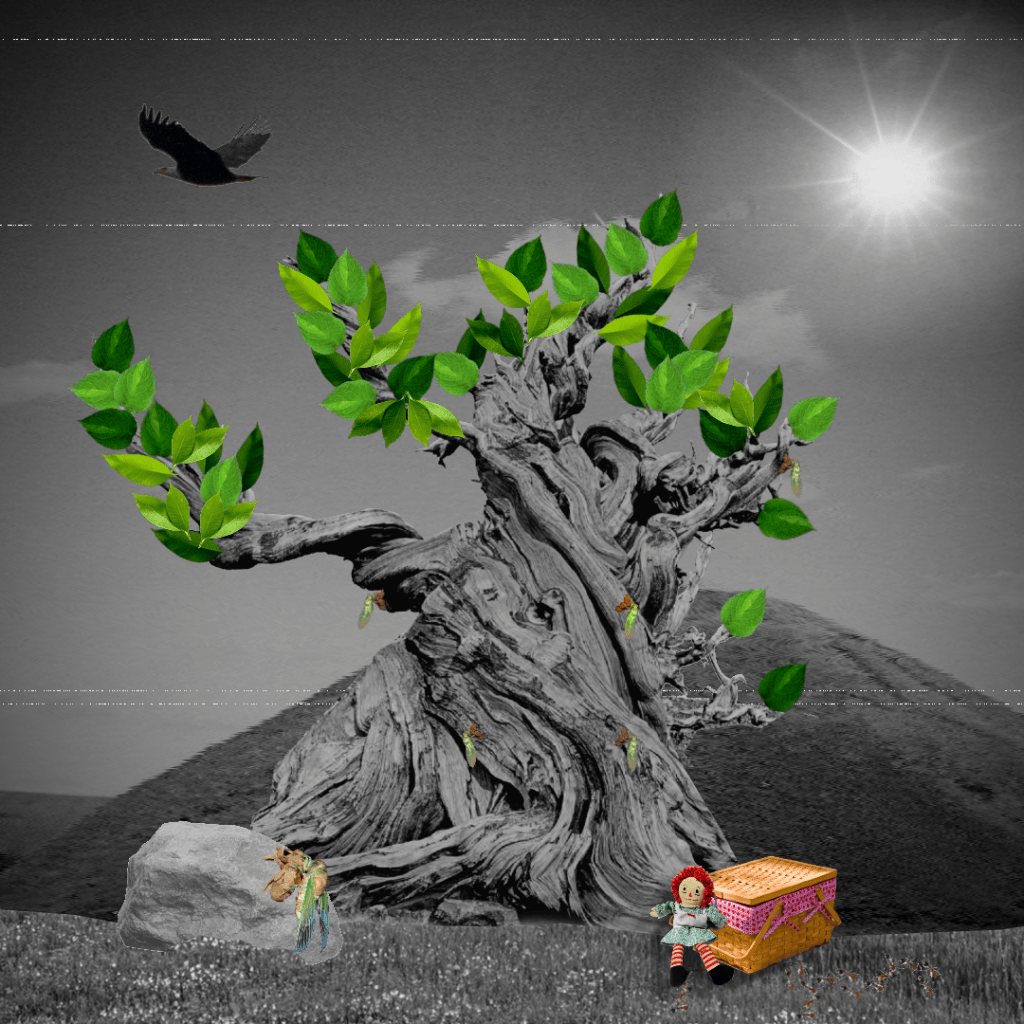
“The summer season, when the fruits of the earth ripen, is often represented as a bare-breasted woman accompanied by a number of distinguishing attributes: a stalk of grain, a burning torch, and a fruit-filled cornucopia. Her colors are yellow and gold.”
Matilde Battistini, Symbols and Allegories in Art
What is summer horror?
You would think that summer is the least “horror” season, being the time when there’s the most light, laughter, and warmth. But, if you think about that assumption for even a second, it starts to fall apart. After all, is the summer camp slasher not a classic of the horror genre? Do we not spend summer nights around a campfire telling ghost stories?
If there’s one thing that horror likes to do more than lean into vibes, it’s subvert expectations. Summer provides the perfect backdrop for just such an inclination. Horror takes a beach holiday and transforms it into a crime scene; it converts warm rays of sunlight into a burning beam of suffering.
I’ve been thinking a lot about the role of seasons in horror lately (this may or may not be a hint about the topic of the next Slow Burn anthology). Over the course of this summer, starting in June and culminating in September, I’ve been reading, watching, and researching as much summer horror as I could. In this article, I’ll take what I’ve collected over the course of the past three months to explore the common visuals and themes that you can expect to see in summer horror, and why they work so well. This is the first of a four part series I want to write about horror and the four seasons, and, being someone born literally on the summer solstice, I can think of no better season to kick it off with.
Note: This article contains major spoilers for Tananarive Due’s “Summer” and Shirley Jackson’s “Summer People.” The other books, stories, and movies I discuss might contain minor spoilers or vaguely discuss plot points, but I generally try to steer clear of completely ruining the ending. For a full list of all the media that I read/watched or tried to read/watch for this, check out My Summer Horror Watchlist and TBRs on Substack. (Did you know we also have a Substack?)
Light and dark: How summer horror breaks the rules
The sun’s lovely illusions
“This doesn’t scare me. I don’t fear the dark. I know the dark, and it knows me. Within it, I’m safe from the sun’s lovely illusions. I know what I’ve always known: The monsters worth fearing are the ones that are dangerous enough to hide in daylight.”
Ryan La Sala, The Honeys
At night, the monster crawls out from under the bed. When watching horror, I often find myself rooting for the protagonist to just make it through the night. I understand, instinctually, that the light of day will bring salvation. Think of the plot of Halloween (1978), where nightfall brings murderers. Of Ready or Not (2019), where the whole point is staving off death until the morning.
Summer horror tends to invert this expectation. Rather than offering protection, sunlight exposes. It confuses. It blinds. In summer horror, not even the daytime can keep you safe. In Ryan La Sala’s The Honeys, sunlight obfuscates rather than clarifies. The book follows gender-fluid teen Mars as they try to make sense of the death of their sister, Caroline. To do this, they must travel to Aspen Conservancy Summer Camp, a summer camp of the privileged elite, to unravel the mystery of his sister’s bunkmates: the Honeys. Mars, as the child of an upper-class senator, has an instinctive understanding that presentation is not the same as truth. Reality, as exposed by sunlight, is understood as artifice: “[At] night the doubts embolden, and without the sun making me squint I feel a clarity I can’t always find during the day. It’s that clarity that I need to hold on to, above all else.”
Several summer movies are famous for happening in broad daylight. The Texas Chain Saw Massacre (1974) takes place primarily during a hot Texas day; most of the teens that get slashed do so under the watchful eye of the sun. The danger is present and visible, but still impossible to escape. It’s part of what makes Leatherface such a threatening presence. He doesn’t hide in the shadows; he is not the thing waiting to go bump in the night. He is an all-encompassing threat.
“Right after her boyfriend is slain by Leatherface, the ill-fated Pam walks towards the dreaded Sawyer house in search of him. “If the scene is taken out of context, it’s actually quite beautiful,” says [Jonathan Barkan, horror expert and editor-in-chief of website Dread Central]. “A pretty woman with lovely skin walks towards a picturesque house, the camera low but capturing the bright blue sky with puffball clouds lazily suspended in the air.” However, given what we know about the dangers that await Pam inside the house, it’s not long before “the beauty of bright daylight [becomes] a blaze of impending danger,” reminding us that monsters can strike in even the most idyllic and gorgeously lit settings.”
David Opie, Midsommar and the blinding terror of ‘daylight horror’
Midsommar (2019) is another oft-cited example of horror that doesn’t hide from the power of light. It’s set in Sweden during the summertime, where almost every hour of the day and night is brightly lit. The days are disturbingly long, 19-20 hours of straight sunlight creating this sensation of eternal activity. For our group of protagonists, outsiders who are unaccustomed to the light, this is particularly jarring. When are you supposed to rest and recover if the night never seems to come?
Moreover, Midsommar contrasts the literal ability to see everything all the time with the shadowy nature of its cult. What’s unsettling is not what we cannot see, but that we are allowed to see and still cannot stop things from happening. A man throws himself off a cliff in a ritualistic suicide, and all the protagonists can do is watch, agape. As Emily E. Laird says in Midsommar: Horror in the Light of Day, “Violence is exposed by [the long days]… here it is laid bare, brightly lit, and raw for our eyes.”
It Follows (2014) isn’t strictly summer horror, but it has summer vibes primarily because of its use of daylight and pool/beach imagery. Like the sun in Midsommar, the It that follows is incessant, slow but never not chasing after the protagonist. Yes, the nights are also terrifying, but the day doesn’t provide any relief. If anything, the day is worse for the audience, as we can often see, sometimes for several minutes, It approaching from a distance, the protagonist unaware of how near danger looms. The same principle goes for Tremors, which features underground monsters that don’t really care whether or not the sun is out. In fact, they’re drawn to vibrations, so the daylight, when people are out playing basketball and running engines and jumping on pogo sticks, is actually more dangerous.
“Being able to see is an asset, but it doesn’t mean anyone is safe. The sun provides a false sense of security that horror stories can exploit and turn on its head. Daylight horror typically corrupts that which is beautiful. A lovely beach scene is shattered by an eldritch horror emerging from the sea. A magical walk through the forest is ruined by a masked murderer charging out of a bush. A midday suburban block party descends into screaming and bloodshed as the town’s dark secrets are revealed by bright light. Daylight horror asks the audience to see fear, where they usually see everything else.”
Joshua Kristian McCoy, The Daylight Horror Subgenre, Explained
In summer horror, there’s often that moment when everything snaps out of place. When a pleasant summer day turns violent. The Summer Hikaru Died (2025) frequently uses this device, flip-flopping between cozy moments of camaraderie and terrifying slips into the malignant supernatural. From the opening scene, it uses the warmth of daylight to expose the cold undercurrent of its plot. After disappearing into the forest for several days, teen boy Hikaru comes back wrong. His best friend, Yoshiki, senses it instantly, but waits several months to confront him. The show opens with a classic summer scene: Hikaru and Yoshiki eat ice cream on a warm afternoon, slouched before a shop front. Cicadas hum. Fields of corn (I think… I’m not a botanist) rustle in the soft breeze. All is well. Until Yoshiki brings up the forbidden topic: “You’re not really Hikaru, are you?” The scene goes silent, overcast. All that was known and comfortable is replaced by an urgent sense of danger. Cosmic goo bursts from Hikaru’s face. “How did you know?” asks the boy who is no longer Hikaru.
The depths of contrast
“Put light against light – you have nothing. Put dark against dark – you have nothing. It’s the contrast of light and dark that each gives the other one meaning.”
Bob Ross, Happy Little Accidents: The Wit and Wisdom of Bob Ross
In the winter, we expect the dark and the cold. So, we hunker down. We light fires and turn our home into a nest. We create the coziness that the outside world denies. In the summer, with its long days and warm air, we don’t think to. So, when the bleak night comes, we are all the more unprepared.
“Burnt hills wave gently in the shimmering heat. The sun is sinking fast now, lengthening shadows and stringing the sky with reds and pinks. Darker blues push their way through them even now. The last of the light fades…”
Lisa Fuller, “Don’t Look!”
In Friday the 13th (1980), there are dangers in the day, certainly, but night is when it all comes to a head. In the day, it feels like the people who die accidentally stumble into their deaths; in the night, all who are killed are hunted. The light is not only unsafe, but the dark is that much more terrifying by contrast.
“[I remind] myself of the real world, where the paranormal and ghosts are just fiction. In the bright light of day, I’d probably laugh my arse off.”
Lisa Fuller, “Don’t Look!”
Sinners (2025), for example, uses daylight as a framing mechanism. Its beginning and end feature the same scene: Sammie appearing at a church door, covered in blood, clearly having survived an ordeal. What changes is our understanding of what happened. The first act of Sinners takes place the day before Sammie appears at that church. Under the light of a watchful sun, Sammie and his cousins Smoke and Stack prepare what looks to be a very promising opening night for the cousins’ club. The sky is wide and blue above them, hopeful in a bittersweet way. We know how this ends; we can see all that potential that’s just waiting to be dashed away. If the sun is freedom, then we know what awaits when night falls and the terrors emerge.
“Sammie: You know something? Maybe once a week, I wake up paralyzed reliving that night. But before the sun went down, I think that was the best day of my life. Was it like that for you?
[REDACTED]: No doubt about it…Last time I seen the sun. And just for a few hours, we was free.”
It’s too damn hot: the tyranny of a summer sun
“July wore into the dog days of August. The heat fell like a guillotine blade at first light. By noon you felt as if you were breathing through boiled wool.”
Craig Davidson, The Saturday Night Ghost Club
Mad blood stirring
“I pray thee, good Mercutio, let’s retire.
The day is hot, the Capulets abroad,
And if we meet we shall not scape a brawl,
For now, these hot days, is the mad blood stirring.”
William Shakespeare, Romeo and Juliet
Anyone who’s ever had to do an errand underneath a beating sun, when the air is so stifling it feels thick and every movement requires Herculean effort, understands what I mean when I say that heat and rage are interwoven. This is an association that goes way back in human history. As Matilde Battistini explains in Symbols and Allegories in Art, “During the Renaissance, the complex system of correspondences between macrocosm and microcosm, the summer season was associated with fire, the choleric temperament, and the iconographic motif of the five senses.”
The language of “hot=tempermental” and “cold=calculating” can be weaponized by colonialists who moved from literally cooler climates to hotter climates in the Americas, Africa, and the Global South as a way of justifying their claim on the land. It’s where you end up with tropes like the “hot-tempered Latina.” Getting into that is a whole other article, but generally speaking, I’ve tried to focus on examples that don’t fall into that category. I sought out characters for whom rage is something personally necessary, a reaction to grief or repression.
For instance, Stephen Graham Jones’ I Was a Teenage Slasher uses the framework of a “slasher story” to explore its protagonist Tolly’s grief over the loss of his father. A hot sun and bright, flashing violence have been codified into the slasher genre through films like The Texas Chain Saw Massacre and the X trilogy (2022-2024); I Was a Teenage Slasher uses and builds on that trope. The book opens with a tongue-in-cheek line that both highlights the violence of summer and Tolly’s inability to earnestly acknowledge his own suffering:
“It was the best of times–high school–and it was the suckiest of times: high school.
Would I trade it, though?
If I could unkill six people, not make the whole town of Lamesa, Texas gnash their teeth and tear their clothes and have to go to funeral after funeral that searing-hot July?”
I Was a Teenage Slasher centers on Tolly’s transformation into a “slasher,” an iteration of the serial killer from horror movies made into a supernatural creature. When Tolly is infected with tainted blood, his tenure as a normal human boy comes to an end. In the book, a “slasher” is a creature of vengeance and violence, a shadow self that takes over its host to enact righteous judgment on those it perceives as having wronged it. When we meet Tolly, before his transformation, he is a hot mess. He has only one friend; his father recently died, and he’s taking it as well as you can expect; he drinks too much to cope and acts like an asshole as a result. And all of that is on top of his already being known in his small town of Lamesa as the village weakling; his severe nut allergy makes him the reason why, every school year, a nurse has to come give a talk with his class about allergy awareness. All of that suffering roils within Tolly, and he has no real way of expressing it.
As a “slasher”, though, the response becomes simple. I was wronged, so I avenge myself. My driving motive? Fury:
“That little hatch in the top of the camper opening like it had, unhooked from its metal arm, it was making my blood feel like it was boiling.
I think rage is the word, but that one syllable doesn’t quite cover how all-consuming this feeling was.
It was summer, though, wasn’t it? It was summer, and the two of you would be long buried by the time fall semester rolled around.”
Anger, then, becomes a maladaptive coping mechanism for a boy who, until now, has swallowed his emotions and left truths unsaid. It is the release of several years of building pressure: equal parts cathartic and horrific. The Honeys takes the concept of righteous anger even further. Mars is in a similar boat to Tolly: grieving the death of a loved one, seeking answers. Though Mars does a lot less damage than Tolly, they also find a path through anger. Initially, they cannot name it, seeing on one side their all-encompassing pain and on the other a suffocating sun:
“There are a few explanations for my sudden, nauseating reverie— grief, I have learned, cracks us into pieces that make all sorts of strange, alarming shapes-but I decide upon heatstroke. The sun is inescapable out here. The air thick enough to chew.”
But eventually, they find a place to put all their suffering. They land on rage, not only at the camp that othered and rejected them, but at their sister for choosing to ally herself with it:
“Finally, I feel what I’m supposed to feel. Anger. The snarling grudge I’ve been tending to summer after summer, as Caroline fled to Aspen without me. With them. She chose them-these rich, glossy dolls-over me, over us, and I’ve hated them from afar for years.”
Heat as oppressive
“It’s stinking hot inside, an oppressive stillness. Looking around, I can see every single window and door is open, but nothing stirs.”
Lisa Fuller, “Don’t Look!”
Let’s go back to the image I conjured at the start of this section: a beating sun, an inescapable heat. Summers can be suffocating; there is a point in which you’ve removed every article of clothing possible, but you’re still boiling. In this way, heat serves as an apt metaphor for the systems and emotions that surround and drown us, invisible yet oppressive.
In the realm of the personal, a common emotion that horror comes back to, time and time again is grief. Like several of the texts throughout this article, Lisa Fuller’s “Don’t Look!” features a young girl grieving the death of a family member, this time a brother. She and her family are returning home for the first time since her brother’s death. Like the stifling Australian heat, the fact of his being gone seems inescapable:
“I shove my face against the window frame, letting the breeze brush over me. Wishing it was cool. No relief is coming. Not even after the sun goes down. Mid-summer afternoons in our rural hometown are my worst nightmare. We only rolled into town an hour ago and I already want to escape.”
As Alex Henderson puts it in “Hot-weather Horror and The Summer Hikaru Died”, “[Don’t Look! creates] a tangible sense of cloying claustrophobia. Rather than light and warmth being good things, they’re sources of horror.” The characters find themselves in constant physical discomfort: sweat dribbles into eyes and soaks into sofas, dust fills the air, tepid water offers no relief. The suffering bears down upon them.
Beyond the personal, many of these summer horror stories use the pervasiveness of heat as a way to critique systems of power. Yes, The Honeys is about Mars’ grief, but it’s also about them coming up against the social structures of binary gender. What’s oppressive to Mars is not merely the loss of Caroline, but the need to be back in the deeply gendered environment of summer camp. In order to gain the entrance that’s required for their investigations, Mars must conform to a binary. The only way they’re allowed back at the camp that they were already run out of, years ago, because of their non-binary identity, is to be willing to stay in the “boy” cabins and participate in “boy” activities. Anger becomes a logical response for Mars, especially as it’s one of the few acceptable emotions within the masculine palate:
“Even Wyatt emanates a tamped fury. It spreads to all of us, rising as the blazing sun burns off the morning mist.”
The blazing sun can act as a metaphor for a wide range of systems of oppression. In Sinners, we see the pervasiveness of white supremacy in the hot yellow sun that burns down on the Black sharecroppers. In The Summer Hikaru Died, we feel the physical discomfort of a sweltering sun alongside Yoshiki’s emotional discomfort being queer in an environment that’s explicitly heteronormative. The sun becomes claustrophobia incarnate.
Across several mythologies, the Sun is connected to masculinity, so it’s no surprise that feminist horror often uses sunlight as a symbol of patriarchal oppression. Charlotte Perkins Gilman’s “The Yellow Wallpaper” is one of the most iconic pieces of early feminist literature. It’s a story about a woman being treated for a nervous disorder at the holiday home that she and her husband have secured for the summer. The husband is not only a doctor but her doctor, and decides that the only cure will be total isolation and bedrest for the duration of the summer season. It’s obvious to a modern audience with a better grasp of mental health that maybe being locked in a room all alone for weeks on end won’t cure depression, but the protagonist has little recourse against the authority of her husband:
“John laughs at me, of course, but one expects that in marriage.
If a physician of high standing, and one’s own husband, assures friends and relatives that there is really nothing the matter with one but temporary nervous depression—a slight hysterical tendency—what is one to do?
My brother is also a physician, and also of high standing, and he says the same thing.”
The story is inspired by Perkins Gilman’s own experiences being treated for post-partum depression, when the proposed “cure” of total rest ended up causing more harm than good. Throughout the story, there runs a deep understanding of how patriarchal attitudes result in women being mistrusted about their own experiences. The protagonist of “The Yellow Wallpaper” is physically trapped within a room of the house, but she is also societally trapped by authoritative men who value their judgements over her own. The story plays on the contrast between the concept of a summer holiday and the protagonist’s imprisonment. There is a “delicious garden” at the estate, but she must appreciate it from a barred window.
In the works of Ira Levin, both in print and on screen, we also see a connection between the bright daylight of a paternal sun and the disregard for women’s liberation and autonomy. The film adaptation of The Stepford Wives (1972) has a particularly summery feel; its bucolic environment in the sun-drenched lawns of suburbia urges a sense of beauty, so long as all the rules are followed. As Jonathan Angarola explains in Welcome to the Neighborhood: The Stepford Wives (1975), “Most of [The Stepford Wives] takes place in the confines of Stepford, which features bright saturating sunlight, green trees, and tall grasses swaying softly in the breeze. Cinematographer Owen Roizman in essence captures those more lazy and leisurely summer days, which belie the darker machinations of the town and the looming threat to its married women.”
Quick trigger warning before I proceed: the rest of this section is about Rosemary’s Baby (1968), so I am going to cover the topic of sexual assault. Skip ahead to the next section if you’re not in a place where you feel comfortable reading about that.
In Rosemary’s Baby, the connection between weather and patriarchal suffocation is even more explicit. The story follows young couple, Rosemary and Guy, as they move into a new apartment building and begin trying for a family. Though the couple has agreed on the end goal, the scene of Rosemary’s impregnation is nonconsensual. She and Guy are meant to have sex that evening, but, feeling unexpectedly unwell, she falls asleep before they can. That evening, she suffers an assault. Her experience of it is filtered through a harrowing dream sequence that juxtaposes images of summer respite with the horror of a rape.
“‘Just get a nap,’ she said, and was sitting with a drink in her hand on President Kennedy’s yacht. It was sunny and breezy, a perfect day for a cruise.”
Becomes…
“Typhoon! It killed fifty-five people in London and it’s heading this way!” And Rosemary knew he was right. She must warn the President. The ship was heading for disaster.
But the President was gone. Everyone was gone. The deck was infinite and bare…”
Which becomes…
“Protest woke in her eyes and throat, but something covered her face, smothering her in a sweet stench. The hugeness kept driving in her, the leathery body banging itself against her again and again and again.”
At the time the book and film came out, marital rape in the United States was still legal. Rosemary has no recourse for her suffering; she understands that she was assaulted (Guy admits, the next morning, what he did), but there’s nowhere she can put that. The pregnancy that results, wanted by her, is a difficult one. It is as though her unspoken emotional pain transforms physically, worsening as it gestates: “Until now it had been inside her; now she was inside it; pain was the weather around her, was time, was the entire world.”
Rosemary is due to give birth in the summer. The movie makes the connection between her claustrophobia and heat explicit; her final weeks of pregnancy are seen out by an unprecedented heat wave that settles over New York, blanketing the city. But even in the book, which features only the normal temperatures of an East Coast summer, heat is a binding force. When heavily pregnant, Rosemary discovers that her husband lied to her about something important, something that changed the way she sees him. The discomfort of the lie, the discomfort of her pregnancy, and the discomfort of the sweltering day all blend together:
“She walked west on Fifty-seventh Street, walked very slowly with the bigness of the baby hanging before her and her back aching from withstanding its forward-pulling weight. The day was hot and humid; ninety-two already and still rising. She walked very slowly… she should never have gone out at all today. It was too hot and sticky.”
Whether it’s a system of power or an overwhelming emotion, the thing that weighs down upon Mars and Yoshiki and Sammie and Rosemary and the unnamed narrator of “The Yellow Wallpaper” is both invisible and all-compassing. It places them within a sweltering pressure cooker, hijacking their every thought with a reminder of what binds them. It’s so hot. They’re gonna know how I really feel about him. It’s SO hot. I am never getting out of here. It’s SO FUCKING HOT.
The unique summer imagery of horror
Insects: a buzzing terror
“As you lay on a summer’s day
In a cool and shady place,
Don’t look up into the skies;
Instead look down and squint your eyes.
Squint your eyes so very tight,
And if you wish with all your might,
You’ll find the land of More-Than-Small.
In this land live buggs — that’s all!”
Stephen Cosgrove
Probably one of the most tangible horrors that we experience in summer IRL is the proliferation of insects. You want to lay in the cool green grass, but you know it’s crawling with ants; the long dusky evenings cannot be spent outside without suffering a constant bombard of blood-thirsty mosquitos. In many parts of the world, the scream of cicadas becomes the soundtrack of the season.
Horror is already prone to loving creepy crawlies, but for the summer, it doubles down. The Summer Hikaru Died in particular brings us close to nature in all its six-legged glory. Visuals will often flick back and forth between a sunlit bike ride and a crawling beetle; a window streaming warm sunlight and a cicada stuck mid-molt. In the opening scene, the sound of cicadas is used to mark the change between “before” when it’s a nice summer scene and “after” when Hikaru reveals the monster within. The buzz of cicadas is omnipresent, but dies away completely as Yoshiki asks his narrative-shattering question.
Where The Summer Hikaru Died gets plenty of mileage out of the humble cicada, The Honeys turns to bees. Caroline’s old bunkmates “The Honeys” are called that because they are literally the apiary wing of the camp. The girls, separated from the rest of camp by a lake, both act as beekeepers and seem bee-like themselves. It’s a literalization of the term “queen bee” that’s often applied to popular girls.
From the very first few chapters, we understand that something is not right with these damn bees. At Caroline’s funeral, Mars is disturbed by the sight of an insect disappearing into Caroline’s ear: “I see the dark shape of the bees cut through the dim light above the casket, landing on Caroline’s throat, her lips, her eyelid.” When Mars arrives at camp, summer and insects are portrayed as both inextricably intertwined and offputting: “Through the trees I glimpse neon fields, stone walls laced with ivy, and red-stained buildings aflame with afternoon sun. The invisible bugs envelop us in their chanting. This is how Aspen has felt to me all these years away; like the specter of summer itself, a warmth that could be recalled but never felt.”
Other works of summer horror feature supernatural monsters that are insect-like in their manner. What are the monsters of Tremors if not giant carnivorous worms? In Tananarive Due’s “Summer,” evil spirits swarm the swamp, possessing infants under two. Bugs are a fact of summer in the story’s setting: “With the Okeepechee swamp so close, mosquitoes and flies take over Graceville in summer.” The evil spirits are directly connected with insects. Described as “leeches”, their arrival is foretold by several flies landing on the face of a sleeping infant.
“I’m not scared of bees. Not usually. A bee is a tiny thing, easy to crush.
But seeing them this way, as pixels merging into incomprehensible magnitude, my mind can’t help but do the math. Crush one, be crushed by millions.
So maybe I am a little scared. Just a smidge.”
Ryan La Sala, The Honeys
Summer storms
Where I grew up, summer is rainy season. I remember spending many afternoons on my porch, air warm and soupy, watching the sky open up. A summer storm is a downpour, a calamity, a drowning, a catharsis. While “dark and stormy nights” are a cliche of more autumnal horror, summer horror also occasionally features this kind of summer storm. Both Shirley Jackson’s “The Summer People” and Daphne Du Maurier’s “The Pool” culminate with a summer storm that feels almost existential. (More on those later)
One of the movies that I think best captures the feeling of a summer storm is Bodies, Bodies, Bodies (2022). The film features a group of (mostly) privileged young adults hunkering down for a “hurricane party” at a family mansion. The contrast between the terror of a storm outside and their flippant attitude to both their circumstances and, honestly, most things, is part of their doom. As the storm approaches, they sip champagne in the pool, utterly unconcerned. When the sky opens up, they must hunker inside, trapped by the torrent of water and their own mistrust of one another.
The existential sun
“I can feel it coming – that familiar dread that settles in my bones as the days stretch longer and more punishing.
…Soon the very act of breathing will become an ordeal, each step outside a confrontation with air so thick and hostile it feels like drowning on dry land. The sun ceases to be a source of life and becomes instead a cosmic interrogator, beating down with the relentless rhythm of existential punishment. You begin to suspect this is what purgatory actually looks like – not fire and brimstone, but endless strip malls baking under merciless light.”
Sarah Elizabeth, My Summer Folk Horror Survival Guide
Okay, so I don’t actually have examples for this one, because I think it’s an emerging association with the season, but summer feels a little existential to me now. It’s not just the season when it’s hot. It’s the season of drought, of fires, of hurricanes. It comes earlier each year, and overstays its welcome. In the summer, it feels impossible to not feel like we are seeing the effects of climate change in action. While long, sunlit days should feel like a boon, they start to take on a different character. If it gets too hot, or is nice for too long, I begin to feel that dread of “what are we doing; what have we done?”
The Sun becomes, then, not a source of life, but a source of existential dread.
“The weather ain’t the way it was before
Ain’t no spring or fall at all anymore
It’s either blazing hot or freezing cold
Any way the wind blows.”
“Any Way the Wind Blows,” Hadestown
Beaches, boardwalks, and holiday: Summer vacation as a site of horror
A ruined afternoon
“For them an idyllic summer afternoon drive became a nightmare.”
Opening title card of The Texas Chain Saw Massacre
Summer months have a vacation feel to them for both natural and social reasons. They are a time of leisure and calm, when the days are long and sun welcoming. Outside is as accessible as ever. Summer usually comes with a holiday during the school year; in the Northern Hemisphere, it is the longest time off you get. I grew up with long summer vacations so now, even as an adult who doesn’t get a regimented break, July feels like a time for respite.
Because of these positive associations with leisure, summer horror is often the tale of peace interrupted. The moment when characters are meant to take a break and indulge becomes the site for violence. The discomfort comes from the dissolution of order. It is simply not right that you should be suffering at a picturesque lakehouse in full view of the sun.
“Caroline used to be the most easygoing person, always up for anything. She looked forward to Aspen every year, except this past year something changed. She became anxious, and it only got worse as summer closed in on her. Caroline felt something bad coming with the season. She saw signs none of us could see.”
Ryan La Sala, The Honeys
Summer horror declares that there’s no such thing as a break. There is no escape. In Due’s “Summer”, this theme goes so far as to turn summer into a cursed month, one that is actively unsafe for mothers and infants:
““Your grandmama never told you nothing about summer and babies?”
Danielle stared at her cousin, whose eyes were slightly small for her face. “You lost me.”
“Just be careful, is all. Especially in July. Summer solstice. Lola may seem strong to you, but you gotta pay special attention to any baby under two. It’s always the young ones. And now that those bones have been unburied, you need to keep an eye out.””
In spite of her cousin’s warning, Danielle’s infant daughter becomes possessed by one of the “leeches” that preys on the young. Though disturbing, the transformation in Lola is not a classic possession in line with what happens to Regan in The Exorcist (1973). Sweet Lola is not replaced by some monster version of herself. It’s the opposite; she becomes docile. Calm where she’s normally fussy:
“Danielle had tried to conceive for two years, and she would always love her daughter—but she didn’t like Lola much in summer.”
Unlike a demonic possession that is a serious threat to the host’s life, the leeches aren’t inherently deadly nor permanent. “The babies change, but by fall they change back.” Initially, Danielle’s horror comes from her daughter’s transformation. Over the course of the story, this horror is replaced by something even more disturbing: relief. Leech Lola is an infinitely easier child to mother; leech Lola doesn’t shriek bloody murder or scratch at her mother’s face.
When Danielle is given a tonic that she can use to turn Lola back now, before the autumn, she hesitates. Towards the end of the story, she runs into Old Man McCormack. Recently, several human bones were uncovered on McCormack land, unearthing the depths of the family’s dark past. They were already known as descendants of slave owners; now murder is added to the charge. Throughout the story, several characters, including Danielle, express disdain at the McCormack family. But, when Danielle runs into Old Man McCormack, she leaves her judgments unspoken, seeing in herself a similar impulse to hide her sins from the judgement of others. He compliments her on her “pretty little girl,” and she wishes him a good summer:
“Maybe the McCormack family would have to answer to God for those bodies buried on their land, or maybe they wouldn’t. Maybe Danielle would give Lola six drops of Uncle June’s remedy at midnight tonight, or maybe she wouldn’t.
She and this old man deserved a little peace, that was all.
Just for the summer.
Danielle rubbed the top of Lola’s head, gently massaging her neatly braided scalp. Her tiny visitor in the stroller turned to grin up at her with shining, adoring eyes.”
The politics of vacation
A vacation is not a politically neutral concept. Even the statement “summer is a time for rest and relaxation” begs the question: “for whom?” Who gets the privilege of leisure? No film does a better job of asking this question than Jordan Peele’s Us (2019), which follows a middle class family’s beachside vacation getting ruined by the appearance of their doppelgängers, “the Tethered”. As Natalie Pohorski argues in ‘Us’ is the Perfect Summer Movie, Us borrows liberally from the aesthetics of a middle class summer. It’s boardwalks and carnivals. Family cabins by the beach (a second home, of course) and parties with equally wealthy neighbours that also summer here. It’s the economic security that inspires someone to be willing to buy a boat.
Horror often preys on middle class anxieties. The early slasher films use suburban settings to imply that no one, not even the people who are “supposed” to be safe, is actually safe. While the implication of suburbia as a neutral, familiar environment can be limiting, Us actively engages with this assumption. It leads us to wonder what makes (the presumed) “us” so deserving as the privileged point of view.
Us blatantly critiques the system of unequal wealth distribution. The Tethered are the shadowy counterpart to each living person’s soul, forced to live underground in a pale imitation of a life. While Us has empathy for the Wilson family and their suffering at the hands of the Tethered, it extends the same empathy to the Tethered.
In exploring how Us uses duality to explore class consciousness in Jordan Peele’s ‘Us’ Is Not-so-Secretly About Class, Noel Ransome describes the Wilson family as idealized: “For a black man like myself, nothing can be more perfect than a black family at a beachfront cottage. In the case of Us, it’s a whole domestic pipe dream.” Meanwhile, the Tethered represent the reality of disenfranchisement.
Horror can lay bare the social construct implied by summer as a time of leisure. It’s a recognisable aesthetic, in no small part because art that is produced on a mass scale tends to come from those of privileged backgrounds who take the assumption for granted. But, as movies like Us explore, not all get the same kind of access. Or, as Ransome puts it, “While the Wilson family and others bicker on about rocking the fancier tugboat, those with the capacity to be as happy grow darker from fucked up circumstances.”
Summer people
“The town survives on its summer people, Mr. Whitman. Call it parasitic, if you will, but that’s the way it is. The host animal comes every summer, and Amity feeds on it furiously, pulling every bit of sustenance it can before the host leaves again after Labor Day. Take away the host animal, and we’re like dog ticks with no dog to feed on. We starve.
Peter Benchley, Jaws
Something that I kept coming across in all these iterations of summer horror was the dichotomy between “summer people” and “full timers.” Tourist traps are common settings of summer horror movies (again, coming back to that concept of vacation). This creates a unique blend of demographics that, throughout the majority of the year, do not interact.
“In summer, all the little communities around West Texas kind of remix, people from Colorado City showing up in Monahans for a couple weeks–grandparents–people from Big Lake working for a week at their aunt’s flower shop in Odessa.”
Stephen Graham Jones, I Was a Teenaged Slasher
Generally speaking, summer horror sides with the local. Tourists are presented as a necessary evil, an other that feels entitled to the space as though they actually belonged. They are de-individualized, a mass of interchangeable affluent faces that must be endured but not accepted.
“Cataract City is perma-tacky, but you come to love it the way you’d love an ugly dog with a sweet disposition…The population swells when the tourist tide washes in each summer-that spree-spending, sunburned horde-but they clear out come late August, leaving nothing but their money. Just enough babies are born at the Niagara Gen to compensate for those who are lost in the retirement castles strung down Dunn Street.”
Craig Davidson, The Saturday Night Ghost Club
In nowhere is this dichotomy between tourist and local more apparent than in Jaws, both the movie and the book. The central thrust of the story comes from a beach town being beset by a bloodthirsty great white shark, and town leadership being unwilling to close the beach to the tourists that they rely on to keep their economy afloat. The monetary incentive is an albatross that hangs on the neck of every Amity citizen:
“It was the beginning of the summer season, and Brody knew that on the success or failure of those twelve brief weeks rested the fortunes of Amity for a whole year. A rich season meant prosperity enough to carry the town through the lean winter. The winter population of Amity was about 1,000; in a good summer the population jumped to nearly 10,000. And those 9,000 summer visitors kept the 1,000 permanent residents alive for the whole year.”
The book, even more so than the movie, gets into the economic and social disparity between tourists and locals. Locals, already privileged before they arrive at Amity, receive a place of privilege in the town’s hierarchy. Crimes are hidden to avoid a panic; shoddy craftsmen are run out of town to maintain a high standard of carpentry for the summer residents. The tourists are even held to different standards under the eye of the law:
“If one of the wealthier summer residents of Amity was arrested for drunken driving, Brody was willing, on a first offense, to book him for driving without a license, and that charge would be duly reported in the Leader. But Brody made sure to warn the driver that the second time he was caught driving under the influence he would be charged, booked, and prosecuted for drunk driving.”
All of this leads to an illusion being built for those summer people that this place they spend their summer months is a home for them too. You can understand why: it’s familiar and peaceful. They are blind to the fact that they experience an amusement park version of their so-called second home. But the residents: they know otherwise.
Ryan La Sala’s The Dead of Summer explores the divide between local and tourist. Set in Anchor’s Mercy, a bucolic island town off the coast of New England, the book opens by contrasting two teen boys riding the ferry back to the town after several months away. Ollie, the book’s protagonist, is returning home after nine months on the mainland where his mother completed a round of cancer treatments. Sam, Ollie’s romantic interest, has a family home in Anchor’s Mercy and has spent every summer there for as long as he can remember. While the boys bond, Ollie rebuffs Sam’s attempts to claim familiarity with Anchor’s Mercy. Through their light-hearted conversation about “summer people” and “townies,” we are led to understand that, though they both spend a large proportion of their life in a similar space, their experiences are incomparable.
“Families who owned summer homes in Amity had been coming out for weekends since the beginning of May. Summer tenants whose leases ran from June 15 to September 15 had unpacked and, familiar now with where linen closets were, which cabinets contained good china and which the everyday stuff, and which beds were softer than others, were already beginning to feel at home….
“I grew up here.”
“You did? In Amity?”
“No, Southampton. I spent every summer here, from grade school through grad school.”
“Every summer. So you didn’t really grow up there.””
Peter Benchley, Jaws
Shirley Jackson’s “The Summer People” makes a similar observation but inverts the narrative’s perspective. It follows the Allisons, retired New Yorkers who spend every summer visiting their lake cottage, as they decide to stay on a little longer than usual. Though they’re excited by their choice, they don’t understand the full implications of it. Throughout the story, we are also shown how little the Allisons are prepared for what life at the lake actually looks like. The Allisons want to be more than summer people, but don’t understand the extent to which they are outsiders. Their experience of the lake is a curated construction, not reality.
Though they “[love their summer cottage]”, they have “not troubled themselves to put in any improvements.” Their home has no heat or running water, no electricity. They only go into town twice a month and get everything else delivered. They see the lake and the cottage’s rustic charm as sufficient and have no sense of danger.
To them, the lake and town are a kind of home that they believe themselves entitled to, but still above. They distinguish themselves from the locals, using othering, colonial terms such as “natives” when referring to them. These “natives” exist as background characters to the Allisons. Over the course of the story, locals react to news of their staying with trepidation and discomfort. But the Allisons don’t heed their concern because they don’t really respect their authority or even see them as equals, despite wanting to become one of them:
“Mrs. Allison thought, and she looked away quickly to avoid giving any sign of impatience. “I feel sort of like we belong here, more,” she said. “Staying on after everyone else has left.” To prove this, she smiled brightly across the store at a woman with a familiar face, who might have been the woman who sold berries to the Allisons one year, or the woman who occasionally helped in the grocery and was probably Mr. Babcock’s aunt.
“Well,” [Mr. Charley Walpole] said again. “Never been summer people before, at the lake after Labor Day.”
The very evening after they’ve made their decision to stay in spite of all the locals’ warnings, they experience the consequences of their actions. They’re running low on kerosene, but the man who delivers it to tourists doesn’t run his service outside of the summer. Their car engine dies, but they are miles away from another human being. They look around at all the abandoned cabins of their fellow summer people and realize the depth of their isolation.
A summer storm is on the horizon. Earlier, they joked about the coming rain by remarking that it would be “good for the crops.” Now, with their romantic illusion revealed to be exactly that, the storm’s threat feels more tangible. They realize the extent of their underpreparedness, their unbelonging, at the moment it’s too late. The status quo, which they benefited from and acted above, has disintegrated entirely:
“Mr. and Mrs. Allison involuntarily moved closer together, and with the first sudden crash of thunder, Mr. Allison reached out and took his wife’s hand. And then, while the lightning flashed outside, and the radio faded and sputtered, the two old people huddled together in their summer cottage and waited.”
Childhood and the “summer of life”
The glorious days of summer break
“Some of my fondest childhood memories are of reading ghost story anthologies in my room on warm August nights, having convinced my grandma to buy me pulpy paperbacks with garish covers over the school break. Other rites of passage — staying up late, telling ghost stories by summer camp firesides — reinforced the association of hot weather and chilling tales in my subconscious”
Within the year, each season represents a different cycle of life. Summer is childhood and early adolescence, a time when promise comes to fruition but before existential reality sets in. With the end of summer comes the death of childhood, of an existence untouched by the oppressive threat of death.
One of the most common themes across summer horror is “coming of age.” These stories show a full appreciation for the magic of childhood. When you’re a kid, aging is not a march towards your inevitable death but a move towards newfound freedoms: the ability to bike, to enter previously forbidden spaces, to go off alone with your friends, to feel emotions previously inaccessible. You don’t realize until too late that each new milestone brings you closer to the end. You see this sense of freedom in movies like It (2017), where the Losers’ Club freely roams around town on their bikes, building a friendship, uncovering secrets. Yes, they are being hunted by a terrible entity, but they’re also able to band together; as children, they are able to see truths that are inaccessible to the adults that surround them.
The summer camp is a favorite setting of horror movies, a trope popularized by the original Friday the 13th in the 80s. The horror landscape is filled with murderous summer camps, from Sleepaway Camp (1983) to Fear Street Part Two: 1978 (2021). Summer camps bring children and teens away from home, offering both the freedom and terror of isolation.
“Like the suburban babysitter premise of Halloween, movies like Sleepaway Camp transformed a bastion of middle class normalcy into a thrilling gorefest. Representing many Americans’ first taste of life without parental supervision, summer camp offered an accessible combination of familiarity and fear.”
Gavia Baker-Whitelaw, Why Are So Many Horror Movies Set at Summer Camp?”
Summer camp horror tends to explore the fear of parents about what their children get up to when not under their watchful eye. For adolescents in particular, you see a strong undercurrent in a terror of an emerging sexuality. In the summer camp movie, promiscuity is punishable by death.
In “Why Are So Many Horror Movies Set at Summer Camp?”, Gavia Baker-Whitelaw explores the history and realities of a summer camp that make it such a site for terror, referring to both “practical concerns about wild animals and dark forests” and the tradition of campfire stories. The article compares the position of historian Leslie Paris, who points to practical concerns, and historian John Kenneth Muir, who cites social fears. In Children’s Nature: The Rise of the American Summer Camp, Paris talks about summer camps representing a first foray from home into an isolated wilderness. In contrast, Muir “sees summer camp horror as a product of the Reagan era, representing “a reassertion of conservative values” and “Old Testament draconian beliefs.””
Summer camps also bring up that same issue of class that vacation horror elicits. Summer camp is primarily accessible to those of a middle-or-upper class background who can afford the cost to go as campers or the time to go as (often un-or-underpaid) camp counselors.
While originators of summer camp horror show no class consciousness, later iterations tend to lean into summer camp as a potential site where wealth disparity is laid bare.
A class divide underpins the entire Fear Street series, with characters either coming from the impoverished Shadyside or the wealthy Sunnyvale. In Fear Street Part 2: 1978, these tensions come to a head at Camp Nightwing, where both Shadysiders and Sunnyvalers spend their summer. Meanwhile The Honeys explicitly chooses a campsite that’s accessible only to the upper echelons of society; the book explores how the wealthy maintain the social hierarchy and, through that, their status at the top.
Loss of innocence: the dream that ends in waking
“Three years ago, the hot, sticky August rain fell big and wet as I sat listlessly on my porch at home, crying over the way summer would not come again – never the same…August rain: the best of the summer gone, and the new fall not yet born. The odd uneven time.”
Sylvia Plath, journal (age 19)
Where summer camp horror tends to (secretly) focus on the fears of adults about what children and teens get up to when unsupervised, there is another type of summer horror that focuses more on the child’s perspective. Coming of age can feel like a loss; puberty is terrible (let’s be real), adulthood is wretched, and it can feel like an upending of your entire experience of the world.
No story captures this tragedy more effectively than Daphne Du Maurier’s “The Pool” (one of my favorite short stories ever). In “The Pool,” thirteen-year-old Deborah and her brother Roger are back at their grandparents’ country home for the summer, where they go every year. Deborah is an imaginative child, given to daydreams and ritualising the mundane. She revels in childhood; it affects her entire worldview, which is full of wonderment:
“The children ran out onto the lawn. There was space all around them, and light, and air, with the trees indeterminate beyond. The gardener had cut the grass. The lawn was crisp and firm now, because of the hot sun throughout the day; but near the summerhouse where the tall grass stood there were dewdrops like frost clinging to the narrow stems.
The children said nothing, the first moment always took them by surprise. The fact that it waited, thought Deborah, all the time they were away; that day after day while they were at school, or in the Easter holidays with the aunts at Hunstanton being blown to bits… a year was so long. How did the garden endure the snows clamping down upon it, or the chilly rain that fell in November?… The garden had to endure month after month of silence, while the children were gone. Even the spring and the days of May and June were wasted, all those mornings of butterflies and darting birds, with no one to watch but Patch gasping for bread on a cool stone slab.”
Childhood, whimsy, and the summer are inextricably linked in “The Pool.” For Deborah, it goes beyond a holiday into the realm of the spiritual; she stretches out on the grass, “her hands out on either side like Jesus on the Cross” to “offer herself to the earth, to the garden, the garden that had waited patiently all these months since last summer.” She is one with the world; in the evening, the “warm night [claims] her.” The central image of the story is a small natural pool in the woods by the house. Deborah reveres the pool above all else, paying tribute to it every year like a pilgrim.
What Deborah fears, above all else, is adulthood. She understands the magic of childhood better than most, better (she thinks) even than her brother who prefers ball games to those of imagination:
“She was seized with a sudden pity, that same pity which, earlier, she had felt for all people other than herself. How absorbed [her brother] was, how intent on the moment that held him. But tomorrow he would be some old man far away, the garden forgotten, and this day long past.”
It’s not only a love of her situation in life that drives her, but an understanding at it being at odds with the adult world that awaits her. A joyless mundane world, utterly devoid of magic:
“When people grew old they had such few treats. “What do you look forward to most in the day?” she once asked her grandmother.
“Going to bed,” was the reply, “and filling my two water bottles.”
Why work through being young, thought Deborah, to this?’”
When Deborah discovers a secret world hidden within the pool that she so loves, her cherishing of childish fancy only becomes stronger. She visits the pool by night and meets a woman who guards the turnstile at the entrance of the secret world. Deborah understands the urgency and importance of this discovery, arriving right as adolescence looms over her fading childhood:
“Power ran to her fingertips. Excitement was communicated from the waiting trees, and the orchard, and the paddock; the intensity of their secret life caught at her and made her run….now night and the sky above were a vast magnet, and the things that waited below were needles, caught up in the great demand.”
Often, loss of childhood innocence is a theme explored retroactively; an adult perspective looks back at a time they did not know to appreciate until it was over. As Andy says in The Office, “I wish there was a way to know you’re in the good old days before you’ve actually left them.” But the horror of “The Pool” comes from Deborah’s clear-eyed understanding. She knows how precious childhood is; she fears its being taken from her. The day after she discovers the secret of the pool, her thoughts idly stray to the myth of Icarus. She thinks of him stretching towards the sun, doomed to fall. She tries to imagine the “terror” in the “drooping power;” it is the heights he reaches that spell out his death. In the midst of these thoughts, her brother remarks on the heat wave that’s currently plaguing them. He claims their grandfather says it must end soon, and Deborah wonders why:
“Why not forever? Why not breathe a spell so that all of them could stay locked and remaining like the courtiers of The Sleeping Beauty, never knowing, never waking, cobwebs in their hair and on their hands, tendrils imprisoning the house itself?”
Her idealized desire is tragic because of its impossibility; it requires a stunting of growth, for time to freeze and nothing new to ever occur. It cannot be reality because, as the courtiers are all asleep, it requires a state of permanent dream. When Deborah experiences her own fall childhood that evening, it comes as a kind of waking. Her grand discovery of the pool and its secret world, the full understanding of the golden summer that is childhood, is snatched away from her by terrible, incessant reality.
That night, a summer storm rages overhead. From her window, she sees the woman at the turnstile and suddenly realizes this is her last chance to enter its world before it was closed to her forever. She dashes out in the downpour, desperate: “Haste was imperative. If she did not run the turnstile might be closed, the woman would vanish, and all the wonder of the sacred world would be taken from her.” But even so, she is too late. As she runs into the water, into the mud and weeds, the world disappears. She finds herself left behind, abandoned: “The pool that claimed her now was not the pool of secrecy, but dank, dark, brackish water choked with scum.”
The final death rattle of her childhood comes in the form of another, less literal pool. That same evening, she gets her period for the first time. That was what she was, unknowingly, trying to outrun; she perceives its arrival as a betrayal from her own body. I think this might be one of my favorite short stories ever because I’ve never seen my own experiences so clearly reflected. I remember being 12, getting my first period, and being entirely put off by people congratulating me (for what? Something out of my control and inconvenient for the foreseeable 4-5 decades?) Moreover, I detested the implication that getting your period changed you, launched you into the realm of “womanhood.” I was the same child I had always been. There was no grand transformation within, but still I understood it as the beginning of an end. “The Pool” concludes:
“What had happened to her was personal. They had prepared her for it at school, but nevertheless it was a shock…Deborah, her cheek on her hand, stared at the empty sky. The heaviness of knowledge lay upon her, a strange, deep sorrow. “It won’t come back,” she thought, “I’ve lost the key.” The hidden world, like ripples on the pool so soon to be filled in and fenced, was out of her reach forever.”
Childhood, like life, has an inherent end. An optimist might say that this is what confers its meaning, but that feels like a coping mechanism. In Shakespeare’s time, plays that ended in marriage were considered comedies and plays that ended in death were tragedies. Taking a long view of a human life, technically, we’re all living out tragedies. The end of childhood is the acknowledgement of that. But, you cannot stop that tragedy without creating another in the figure of the eternal child.
Peter Pan, our cultural conception of permanent childhood, lives a reality of self-deceit and stunted growth. Sure, it’s tragic that children lose the ability to fly as they age because in creeps doubt, but the alternative is much lonelier. The alternative requires a lie. In J.M. Barrie’s Peter Pan, Peter doesn’t allow the other Lost Boys to talk about their mothers because he doesn’t remember his. His innocence is forced and selfish. The book implies that the reason children can fly is because they are “gay and innocent and heartless.” Moving through the life stages is like a snake shedding its skin: yes, there is loss, but there is also something new. That’s something Peter will never experience.
“It can’t last. It never does. A dream come true is still just a dream, and all dreams end.”
Ryan La Sala, The Dead of Summer
Summer horror that seeks to explore coming of age often appeals to the image of Peter Pan. In the film Lost Boys (1987), the band of vampires that roves the Santa Carla pier takes its name from the gang of boys that follow Peter around Neverland, forever young, forever stuck. In The Saturday Night Ghost Club, we follow a dual perspective that is more typical of coming-of-age stories. An adult Jake Baker reminisces about one summer when he and his uncle Calvin investigated the supernatural forces of his Niagara Falls hometown. During a conversation that twelve-year-old Jake has with his father, we are allowed a glimpse at the fading nature of Jake’s childhood. His father, loving him, chooses to let it live on for just a little longer:
“But …when I was a kid I used to wish Peter Pan would show up at my window. He’d spirit me away to the land of make-believe where I could play all day and never grow up.” [Dad] rubbed his palm over his squished nose. I sensed he was struggling with what to say, or the right way to say it.
“That’s a great thing to believe as a boy. Enjoy it now, Jake, my fine feathered friend, because there’s nothing quite so odd as seeing Peter Pan all grown up.”
“Okay, Dad,” I said dutifully, because that’s what kids said when adults got weird.
He drew me into a rough hug. Stubble grated my cheek.
He smelled of Old Spice and faintly, pleasantly, of malt.
“Up to bed, you strange and beautiful organism.” I left him staring out the kitchen window, waiting for Peter Pan to arrive.”
Like “The Pool,” The Saturday Night Ghost Club understands the inherent tragedy of an ending childhood. Its protagonist is also at the precipice of adolescence; he doesn’t know it yet, but this is his last summer as a kid. The book understands the melancholia that comes with endings: “It was just past seven o’clock but the sky was shading a melancholy blue, as it did toward the end of the summer.”
Even negative feelings experienced in childhood have their own sort of innocent enjoyment, for they are detached from reality and context. You do not yet see how complicated and wide-spread the web of the world is. Adult Jake is a brain surgeon; his fears come from experience, from the times he failed, from the responsibility conferred on him by his patients. Meanwhile, child Jake has fears that are a lot simpler:
“I was scared —with that crystalline, childish fear of being caught and punished. That fear thrashed behind my rib cage like a bird in cupped hands, perhaps the last truly childlike instance of that emotion I’d ever feel. That fear is a kind of magic. As you get older, the texture of your fear changes. You’re no longer afraid of the things you had absolute faith in as a child: that you’d die in convulsions from inhaling the gas from a shattered lightbulb, that chewing apple pips brought on death by cyanide poisoning, or that a circus dwarf had actually bounced off a trampoline into the mouth of a hungry hippo. You stop believing in the things my uncle believed in. Even if your mind wants to go there, it has lost the nimbleness needed to make the leap.”
However, unlike “The Pool,” The Saturday Night Ghost Club, the presence of an adult perspective is there to temper the tragedy of the loss. Deborah is trapped forever by the end of her story in a state of churlish loss. We will never see her grow into the things that she will gain by having, unwillingly, left others behind. Jake grows up, has his own life as an adult. Childhood ends, yes, but the self continues.
It’s just that, on a warm summer night, when the smell of blackberries in the air reminds you of being 11, nostalgia has a way of creeping in. Summer horror sees that tendency in us and digs the knife in just a little deeper:
“But she remembers when the word “friend” could draw blood. She and Gretchen spent hours ranking their friendships, trying to determine who was a best friend and who was an everyday friend, debating whether anyone could have two best friends at the same time, writing each others’s names over and over in purple ink, buzzed on the dopamine high of belonging to someone else, having a total stranger choose you, someone who wanted to know you, another person who cared that you were alive.
She and Gretchen were best friends, and then came that fall. And they fell.”
Grady Hendrix, My Best Friend’s Exorcism
“Summers were bad times for Ellen Brody, for in summer she was tortured by thoughts she didn’t want to think—thoughts of chances missed and lives that could have been.”
Peter Benchley, Jaws
“Life was hard enough in summer already, without death hanging over her head, too… In summer, with Kyle gone, she was almost sure she was just another fool who never had the sense to get out of Graceville. Ever since high school, she’d seen her classmates with babies slung to their hips, or married to the first boy who told them they were pretty, and she’d sworn, Not me. All of those old friends—each and every one—had their plans, too. Once upon a time.”
Tananarive Due, “Summer”
***
Over the course of these last few months, I’ve discovered that there is more summer horror than I could possibly read and watch in one summer. It’s a popular season for the genre, in part because it is an unexpected time of year to draw dread from. Summer horror twists traditionally “peaceful” concepts–warm sunlight, a sandy beach, a cabin in the woods, a thriving beach–into something to be feared. It becomes a story of blinding light, sweltering excess, and the terrifying knowledge that all good things must come to an end.
With autumn just around the corner, I’m excited to change gears for the next article in this series. I foresee long nights curled up by the fire, clutching a mug of tea. Outside, the leaves are painted in shades of scarlet and umber; inside, the ghosts make their home in the growing shadows.


Leave a Reply