

“I do put everything in to be read – read the way allegory was intended to be read.”
Angela Carter, on The Bloody Chamber
Fire Walk With Me (1992) is one of those movies that was only appreciated in hindsight. The Twin Peaks show was cancelled in 1991, leaving fans with a cliffhanger to rival the potential death of Little Nell and a ravenous hunger for answers. When it was announced that David Lynch would be directing a Twin Peaks movie, expectations could not have been higher.
Cue: the backlash.
Fire Walk with Me was virulently detested. Critics panned it. Audiences were infuriated by it, going so far as to boo David Lynch in a press conference at the Cannes Film Festival where it premiered. If you asked a Twin Peaks fan about the movie in 1992, they would have lambasted it as completely unlovable. A waste of time. With all the loose threads left dangling after the cancellation of the show, how dare David Lynch waste over two hours on a prequel?
“[A]fter I saw Twin Peaks — Fire Walk With Me at Cannes, David Lynch has disappeared so far up his own ass that I have no desire to see another David Lynch movie until I hear something different.”
Quentin Tarantino, “Mr. Blood Red: Ella Taylor’s 1992 Quentin Tarantino Profile”
It’s not surprising that Fire Walk with Me met a prickly reception (although it definitely didn’t deserve poisonous loathing). Not only did it offer no new insights into the mysteries of Twin Peaks, but its style and tone were completely different from the show. All elements of soap opera corniness were scrubbed away only to be replaced by the kind of unsettling imagery that reminds you that this came from the mind that also directed Eraserhead. The Twin Peaks show only teetered on the edges of horror; Fire Walk with Me allowed itself to be disturbing.
Nowadays, the tides of public opinion have shifted in its favor. It’s got a 78% audience rating on Rotten Tomatoes, and the British Film Institute has gone so far as to name it the fourth best film from the 1990s.
Twin Peaks, both the show and movie, was my and my roommates’ 2020 lockdown activity. For all three of us, it was not only a great way to pass the time, but our first brush with both the world of Twin Peaks, and the mind of David Lynch. I had no context about any of it. Didn’t know the plot. Didn’t know how people felt about it. I experienced Twin Peaks like someone suspended in a bubble, and in that ignorance (innocence?), I absolutely adored Fire Walk with Me. It seemed to me the perfect continuation of the story of Laura Palmer.
Horror is often described as an exploitative genre, one that transforms pain and suffering into entertainment. Those of us who like horror know that this is reductive, ignoring the potential horror has to provide a safe space to explore that which hurts us most. In this article, I’m going to delve into how Fire Walk with Me uses horror conventions to explore trauma, making tangible the intangible, and allowing the “victim” to reclaim their own story.
Content warning: This article describes sensitive subject matter, including domestic abuse, sexual violence, and incest. Reader discretion is advised.
Allegorical Horror: Literal and Symbolic Meaning
“Significantly, the fantastic elements in the magic realist text cannot be explained away, reduced, or reconciled to its realism…the fantastic event does not turn out to be a hallucination, a dream, an elaborate intrigue, a practical joke, or an outright lie on the part of the narrator, but is part of the fictional world.”
Anne C. Hegerfeldt, Lies that tell the truth: magic realism seen through contemporary fiction from Britain
While Hegerfeldt is talking about fantastic elements in magic realism, I think this concept is also applicable to what I’m going to call “allegorical horror.” In allegorical horror, the supernatural element is simultaneously literal and symbolic. The monster is not just a monster, but also a metaphor. Importantly, understanding the underlying metaphor doesn’t mean that the literal explanation isn’t real. The monster is still a monster. It is not imaginary, or something that can be explained away.
A great example of this is in The Babadook, where the Babadook is both a physical representation of grief and trauma, and also a real hat-wearing monster that can kill you.
In essays about Twin Peaks, critics often question whether BOB, the evil entity that haunts Laura and her father Leland, literally exists. For example, in “Family Romance, Family Violence, and the Fantastic in Twin Peaks,” Diane Stevenson suggests that Twin Peaks “hesitates” between supernatural and natural explanations for the crimes it portrays: “Is Leland Palmer a split personality, and BOB a symbol of the deranged side of Leland? Or is BOB literally a demon who has taken over Leland’s soul?… The universe of Twin Peaks alternates between the psychological and phantasmal, the physical and the metaphysical, and the boundaries between these realms are blurred.”
As Stevenson suggests, the answer lies in the blurred middle. Reading Twin Peaks as allegorical horror renders futile the question of whether Leland Palmer has a split personality. Through this lens, the purpose isn’t uncovering the truth in meaning (what literally happened), it’s about uncovering the truth in feeling (how did I experience it?).
“Don’t look away. Let the fear wash over you.”
David Lynch, “How the Griffin Stole Christmas”, Family Guy (my references are impeccable)
Expressionism: The World as I Feel It
To briefly be an annoying “I took Art History 101” guy, let’s take a quick detour in the world of Expressionism. The invention of the camera in the mid-1800s revolutionized the art world. Here came a device that could exactly capture a particular image; what, then, was the purpose of the artist that could do the same, but slower?
Freed from the shackles of realism, art took a turn towards a different kind of truth: abstracted, reconfigured. A movement that came about in the early 20th century, Expressionism was about taking the artist’s own views, emotions, and realities, and bringing them to life in the world of their art. The world was shaped by their perception.
“A painter paints the appearance of things, not their objective correctness. In fact, he creates new appearances of things.”
Ernst Ludwig Kirchner
In allegorical horror, objectivity is out the door. She’s irrelevant. “The monster” is the culmination of our subjective response to an unspeakable evil made literal. As Gretchen Felker-Martin explains in “The Thing in the Dark: How Art Confronts Child Abuse,” horror’s “facility for drawing emotional reaction from its audience” is what makes it the perfect genre to explore the darker emotions and repressed realities of taboo topics like child abuse.
Fire Walk with Me does not shy away from taboo, exploring everything from domestic abuse to assault to incest. It creates tangible monsters out of the horrors that, in real life, are often ignored or unseen. Miriam Haugton calls trauma a “shadowed space” where that which is unspeakable “struggle[s] in its desire for articulation and acknowledgment.” What Fire Walk with Me and other allegorical horror films do is give a face to the unspeakable. They give shape to its existence. BOB. The Babadook.
By crafting trauma into a monster that is tangible, and thus mortal and possibly defeatable, horror creates a space for catharsis that isn’t normally possible.
“I have had many people, victims of incest, approach me since [Twin Peaks: Fire Walk with Me] was released, so glad that it had been made because it helped them to release a lot.”
Sheryl Lee (Laura Palmer)
Abuse made tangible: the literalization of language
He was a monster. She was battling demons. Her pain followed her everywhere. The language that we use to conceptualize abuse is steeped in metaphor. What Fire Walk with Me and other allegorical horror does is go beyond the metaphor into the realm of literalization.
The root of Laura Palmer’s trauma comes from her repeated violation. BOB, using the body of her father, has been raping her regularly since she was twelve years old. BOB is the face of Laura’s trauma. He is a monster, a demon. He does follow her everywhere.
According to Felker-Martin, in personifying child abuse with literal monsters, horror “gives the phenomenon a form impossible to ignore and which lends a voice to the most voiceless members of society through the revulsion and fear which they inspire.” BOB is a terrifying creature to behold. Props to the actor because that twisted smile genuinely haunts me every time it appears onscreen (and for hours after… I had to bike home at midnight after watching Fire Walk with Me and I biked like my life depended on it).
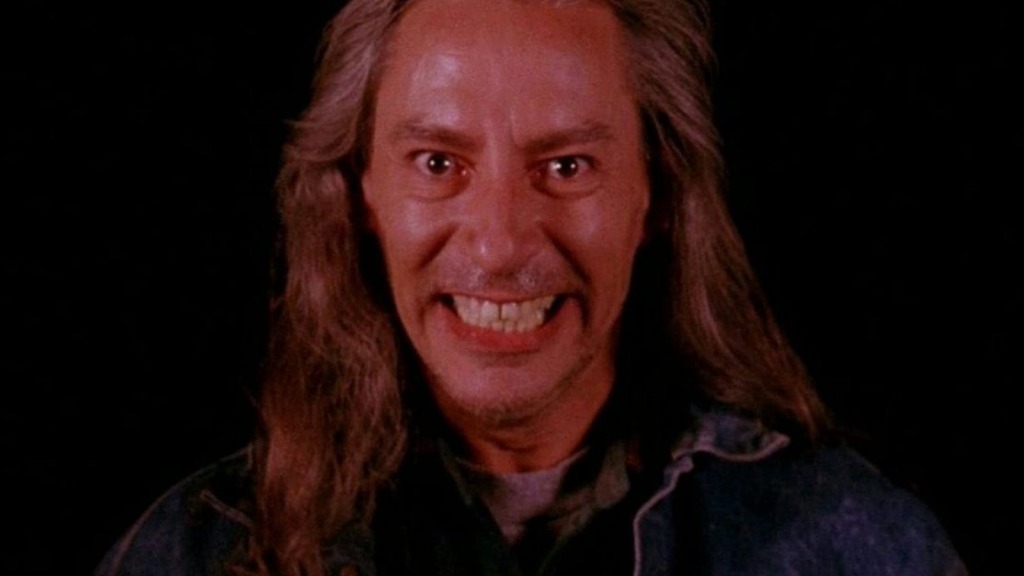
BOB is repellent, as are the things he represents: the insidious abuse that often goes unspoken, the invisible suffering.
A recent iteration of abuse personified that fully embraces this idea is in 2020’s The Invisible Man. This adaptation of the classic H.G. Wells short story adds a horror spin that wasn’t in the original source material by cleverly using the concept of an invisible man to explore the psyche of people in abusive relationships.
The movie begins with Cecilia escaping her abusive husband, Adrian. However, this escape is only physical. The emotional turmoil follows her through to her new “safe” home. Even when told that Adrian has died, her fear remains. As Jenn Adams explains in “The Invisible Man Through the Eyes of a Survivor,” “While there is no logical reason for her to be afraid, she still senses Adrian around every corner. Yes, by the movie’s logic, he probably is there and the threat is real, but PTSD is real, too. Cecilia would arguable have the same fears were Adrian not to torture her from inside his invisibility suit.” The allegory aligns with the film’s central threat.
Like the Invisible Man, BOB operates in the shadows. In one scene, agoraphobe, orchid aficionado, and teen girl obsessive (ew) Harold Smith tries to comfort Laura. He suggests that BOB isn’t real – the wrong thing to say. Her panic flairs; her eyes widen in terror. “He’s real,” she hisses, “YES.” Ultimately, what matters is not whether he’s literally real or not because he is real to her. There is a presence every night that comes into her room and abuses her; there is a shadow of trauma that follows her everywhere.
Simultaneously, Laura’s reactions to BOB operate as a logical response to a supernatural threat that moves in the shadows, and the pervasive fear of living with one’s abuser. She distances herself from her friends and her mood swings violently. She dissociates, an act not just emotionally threatening to her wellbeing but physically dangerous, as it draws her further into the world of the Black Lodge, a mythological place of pure evil. BOB’s ultimate threat is to become her, to completely erode away her sense of self.
It Follows, a movie about a sexually transmitted curse, explores similar themes of feeling imprisoned in one’s own trauma. In “This thing… it’s going to follow you,” an exploration of Rape Trauma Syndrome in It Follows, Camille Zimmerman delves into the similarities between how “It” operates as a movie monster and how sexual assault “follows” its victims after the initial moment of violence:
“Jay immediately begins to exhibit symptoms of [rape trauma syndrome], beginning with the very common experiences of shock, hypervigilance, change in appetite, and increased instances of crying…The way the antagonist hunts and terrorizes its victims is extremely similar to how many people experience the after-effects of trauma. This entity is invisible to people who have not been given the curse at some point, making it extremely difficult for others to have empathy or understanding for victims.”
Deconstructing the myth of a “home” as safe
“Home is the place where when you go there, you have to finally face the thing in the dark.”
Stephen King, It
Horror’s realm is not delimited by derelict houses and brooding forests; it can occur anywhere. If anything, the terror of domestic horror comes from its alignment with familiar figures. Abusive parents, traumatized children, women plagued with disturbing dreams. In describing Stephen King’s breadth of horror writing, professor Alissa Burger explains how “in King’s small towns, even home isn’t safe. While the supernatural horrors and violent histories of Derry and Castle Rock are unsettling enough, the threat of abuse and violence the children face within their own home creates a terror all its own.”
This is the very undertaking of Twin Peaks: to unravel the false image of Twin Peaks as a safe community. The show reveals the many horrors that lurk beneath the town’s humble facade, from abusive husbands (Leo is trash and deserves the worst) to drug dealers to teen sex workers. Fire Walk with Me reduces the scope of perspective, focusing instead only on Laura Palmer’s interior life.
In Fire Walk with Me, we get our first glimpse of the less-than-wholesome Palmer family dynamic. Laura arrives home for dinner and her father instructs her to sit down. Right now. Obedient, she takes a seat, but this only infuriates him further. He uses a critique about her dirty fingernails as a method by which he can systematically tear her down. Her mother does nothing but watch as Leland stands to loom over his daughter, physically dominating Laura in his continued barrage of abuse.
Her mother’s eventual plea for Leland to stop it because “Laura doesn’t like it when you do that” is telling in itself. This isn’t a standalone event, but part of a pattern. This is what makes up the tapestry of Laura’s life. Later, Leland is seemingly temporarily relinquished by the spirit of BOB and his realization of his actions dismays him. So, he goes to his daughter’s room to kiss her goodnight and tell her he loves her, unwittingly continuing to mirror the behavior of an abuser, doling out violence one moment and adoration the next to keep their victim on the hook.
When Fire Walk with Me depicts Laura engaging in drug deals and prostitution, it’s clear that these acts are a response to the domestic abuse she faces. As Julie Muncy expresses, “She’s an abuse survivor struggling to keep from replicating the patterns that have defined her…She turns to drugs and sex, trying to burn away any remaining innocence, out of fear that she’s beyond redemption, or determination to deny Bob/Leland the innocence he fetishizes so dearly.”
One of the core concepts in Twin Peaks and Fire Walk with Me is that violence begets violence. BOB moves through people, spreading his evil wherever he goes. In a representational reading, this vision also holds up. It’s implied that BOB molested Leland when he was young, becoming the part of Leland that eventually molests his own child. It is this cycle of violence that leads Laura to engage in dangerous sexual acts and daily drug usage.
The difference with Laura, and (in my opinion) the central tragedy of Fire Walk with Me are that she attempts to break the cycle of abuse. Her father was hurt so her father hurts her, but rather than taking her pain out on those she loves, she takes it out on herself. When she sees Donna trying to follow her path, she puts a stop to it. Even at her lowest, Laura prioritizes Donna’s well-being. She stops Donna from being assaulted and does her best to mitigate the emotional fallout of what happened. Laura’s main goal is to not let BOB take over her body like he did her father’s. She is trying to distance herself from her abusive past. Unfortunately, her abusive past catches up to her faster than she can run away.
Centering the victim: How Fire Walk with Me lets Laura reclaim her own story
“Open your eyes, James. You don’t even know me. There are things about me – even Donna doesn’t know me. Your Laura disappeared. It’s just me now.”
Laura Palmer, Twin Peaks: Fire Walk With Me
The core trauma in Twin Peaks is the death of Laura Palmer. It is the gaping wound that summons Dale Cooper, the festering rot that plagues the town. Laura Palmer is arguably the most important character in the show, serving as its catalyst. She is the inciting incident. She is also dead from the moment she hits the screen.
Carol J Clover’s Men, Women, and Chainsaws: Gender in the Modern Horror Film analyzes the role that gender plays in the structure of horror plots. She argues, among other things, that horror uses the female body to elicit an emotional reaction from its presumed male audience. Of the Final Girl trope, she says, “tortured survivor might be a better term than “hero”… The point is fear and pain – hers and, by proxy ours.”
The biggest difference between Twin Peaks (the show) and Fire Walk with Me is the positioning of Laura Palmer. The Laura Palmer of Twin Peaks is a device. Her corpse serves the plot while the brief flashbacks we get of her serve the audience – they allow us to better feel her suffering. Meanwhile, the Laura Palmer of Fire Walk with Me is the tragic hero.
As Laura Palmer’s actress Sheryl Lee explained, “I never got to be Laura alive, just in flashbacks; [the movie] allowed me to come full circle with the character.” Fire Walk with Me is a prequel; we know how it’s going to end. But in it, Laura expresses agency for the first time in the run of Twin Peaks. The tragedy at the heart of the show is reframed in the context of its victim. It may be a tragedy, but it is her story to tell.
“The deconstruction of Twin Peaks, the nearly unwatchable intimacy with which it depicts Laura’s trauma, all exist to rewrite the story of Laura Palmer to focus in on this moment, when a living woman embraces her own agency and resists her abuser. Fire Walk with Me is the redemption of Laura Palmer.
But she didn’t need redeeming. Our understanding of her did.”
Julie Muncy, “The Maligned Twin Peaks: Fire Walk With Me Is Better—and More Important—Than You Know”
A girl is not an idea
In Twin Peaks, Laura Palmer is reduced to what she represents to others, not a person but an idea. She exists only as a duality: the pure homecoming queen and the lecherous teenage coke fiend. There is no space for her sexuality to exist as her own. Her body is a tool used to achieve her goals, and a thing abused by those she should trust most. And it is this very misunderstanding that leads to her death. As Felker-Martin explains, “The anxiety our culture feels at the sexual awakening of its young people and the repression which comes as a consequence of that anxiety leaves children more vulnerable to abuse and predation by adults, not less.”
In Fire Walk with Me, we are not only presented Laura as a whole person, but we get to view the world through her eyes. In one of Fire Walk with Me’s most disturbing scenes, we get to see what it feels like to be drawn into the world of sex work. Laura and Donna go to a dive bar where Donna is drugged and almost assaulted. The scene has a seedy glamour to it. The loud music that muffles characters’ voices and loose dream-like dialogue draw the audience in, mimicking the sensation of intoxication that is pulling Donna along. But the scene never lets you get fully drawn in, peppered with discomforting moments that force you to confront your role as a voyeur: an adult man envelops Laura and Ronette, another teen girl, in his arms and proudly proclaims that he’s in “a high school sandwich”; Laura shrieks in panic when she realizes what’s happening to Donna.
“But by using Fire Walk With Me to bring Laura Palmer back from the dead, Lynch pulls off [a trick]: suddenly she’s staring us down not as an abstraction of female purity, but as a real person, flesh and blood that’s yet to be rent and spilt.”
Robbie Collin, Fire Walk With Me: the film that almost killed Twin Peaks
While we see far more nudity and explicit sexuality in Fire Walk with Me than we ever do in the original show, these scenes don’t feel exploitative. Their framing tends to focus on Laura’s disorientation or on her facial expressions rather than on her body. It’s about her experience of the assault, not its visuals. There was even a scene that got cut from the movie where Ben Horne forced Laura to kiss him in exchange for a bag of cocaine. Actor Richard Beymer refused to shoot it because he felt that the lack of character build-up and motivation made it feel exploitative. The movie may not be perfect in its ability to walk the line between gratuitousness and grittiness, but anecdotes like these at least show a behind-the-scenes awareness of the potential pitfalls.
A peek behind the curtain: mental illness recontextualized
“One need not be a chamber to be haunted, one need not be a house; the brain has corridors surpassing material place”
Emily Dickinson
When it comes to exploring mental illness, horror is a mixed bag. There are plenty of completely unwarranted demonizations of mental illness. Specifically, dissociative identity disorder, schizophrenia, bipolar disorder, and psychosis get the short end of the representation stick. At best, they are used for shock value as a plot twist; at worst, they are treated as diseases that make the afflicted inherently evil.
However, sometimes, horror does get it right. I’ve found that effective representations of mental illness are more likely to appear in allegorical horror with supernatural elements, than in more grounded horror like serial killer thrillers. In allegorical horror, there’s less of an incentive to use mental illness as a plot twist. Instead, it’s often the central focus of the film. And, by creating a monster to act as a physical manifestation of trauma, it forces the audience to understand how serious the effects are on the person suffering. It creates a distance between the victim and the monster, showing that they are linked but not one and the same.
Going back to The Babadook, we are presented with a story that’s fundamentally about how to live with the monster. The Babadook is a manifestation of protagonist Amelia’s depression and of her grief over the loss of her husband. It stalks her, systematically breaking her down until she starts to do its bidding. Throughout the movie, she does not act as a model mother. She yells at her son; she threatens him; she hurts him. But as the audience, we understand that the Babadook is to blame. Crucially, the movie doesn’t absolve her of control. The monster is not merely something external to blame and separate from the self. Understanding the Babadook as a part of her is a key step in Amelia taking back control of her life. The movie ends with her not getting rid of the Babadook, but learning how to build a life around its presence.
If you only watched the scenes of Fire Walk with Me where Laura interacts with others, cutting out any scenes where BOB or any other supernatural elements appear, you’d have a very different view of Laura Palmer. She would seem temperamental, flippant, a person who easily discards the feelings of those closest to her. Dramatic, inconsiderate. Bratty. She’d seem exactly like the prom queen that we first met in episode one of Twin Peaks.
But the brilliance of Fire Walk with Me is that those scenes aren’t cut out. Laura’s actions, emotions, and reactions are contextualized within her life and experiences. Objectively, she does things that are cruel to those that she loves. But because the narrative remains so close to her perspective, because her trauma is made tangible through the supernatural, we empathize with her. We understand why she does the things she does.
***
One of the things that I most enjoy about the art of David Lynch is the way that it uses strangeness and the fantastic to represent an emotional truth. Horror is a sensual genre, driven by emotion, both of its characters and its audience. Their fear is ours. By diving headfirst into the horror genre, Fire Walk with Me frees itself from some of the shackles of the show. Because it’s a work of pseudo detective fiction, audiences expected Twin Peaks to deliver concrete answers. The movie distances itself from these expectations, dwelling instead on Laura’s emotions. Sheryl Lee’s performance in the film is probably the best acting we’ve seen from the Twin Peaks cast; Lee takes full advantage of the way that the movie offers Laura an opportunity to reclaim her own story.
At its best, this is exactly what horror does with trauma: it makes the invisible, visible. The terror of the victim is transplanted onto the big screen, not to be ogled but to be understood.


 Slow Burn Horror
brilliant! 53 2025 How Horror Explores Trauma (Why I Really Liked Twin Peaks: Fire Walk with Me) spectacular
LikeLike
great analysis. Just watched it 2025 without knowing it got such a harsh response initially.
when I first started twin peaks the tv show, I’ll admit I kinda rolled my eyes – “oh great another blond prom queen” .. after completing the show, and after fire forces you to inhabit Laura, I see this as a portrait of what happens so often to the young girls in this world. Burdened by unthinkable traumas by those that we were supposed to trust. And sometimes killed for it. It does a beautiful job of painting trauma and how a child / teenager deals with it. No longer are we brushing off “rebellious teen behavior” and looking to what’s going on at home that causes it. Unfortunately, this isn’t too much of a fiction if you keep up with true crime.
LikeLiked by 1 person
I had the same experience of not realizing that it was initially hated! By the time I watched it, we’d collectively realized what an excellent portrait of Laura’s psyche it actually is.
LikeLike