
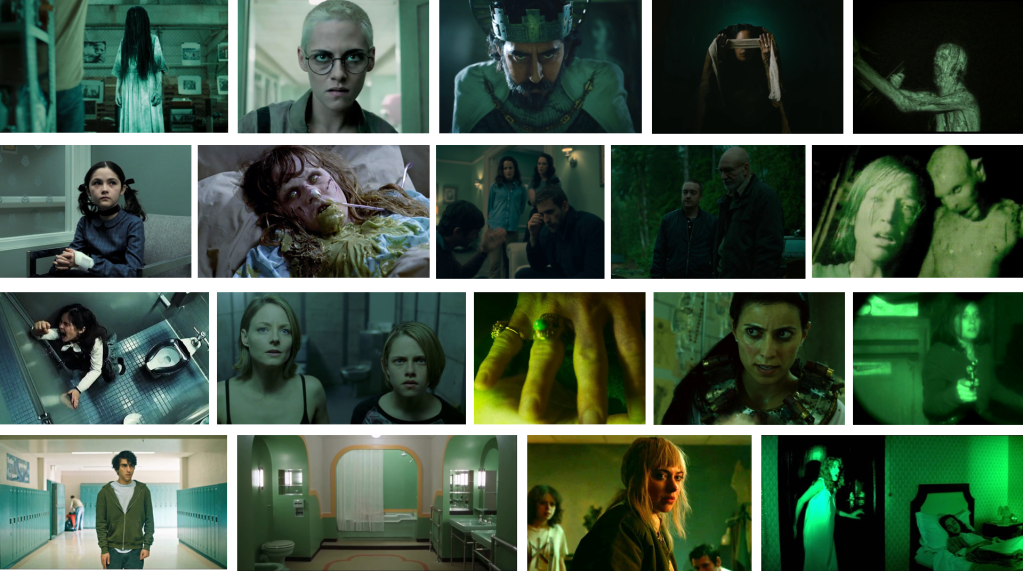
The mint green room seemed to thrum under the neon strip lights. It was as though it had a pulse of its own. I could swear, running my hand over the peeling wallpaper, that I can trace thin veins. Paint flecks stick to my fingertips. I poke out my tongue and let the largest lay gently on it, like a sheet of rice paper. It dissolves, leaving behind a taste like limes and bleach. The light in the room flickers. I look up. There are only two abrasions in the otherwise smooth wall: an ornate yet cracked mirror, and a small clouded window. Out the window, Douglas firs drown the horizon. In the mirror, a strange face grins at me, a poison gleam in its eyes.
This is the bit where I welcome you back to our series on the meaning of color in horror. It is getting difficult to write new, exciting “welcome back” messages, so this is what you get. We’re covering the whole rainbow, so hold onto your socks. You can see an overview of everything here. We’re going rainbow order, so blue is next and yellow came before. Okay we good? Let’s get into it. Green.
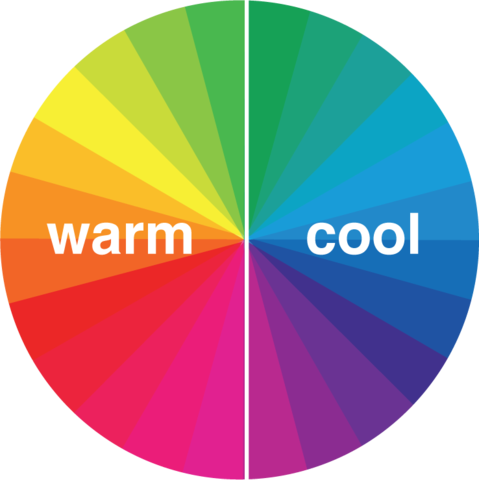
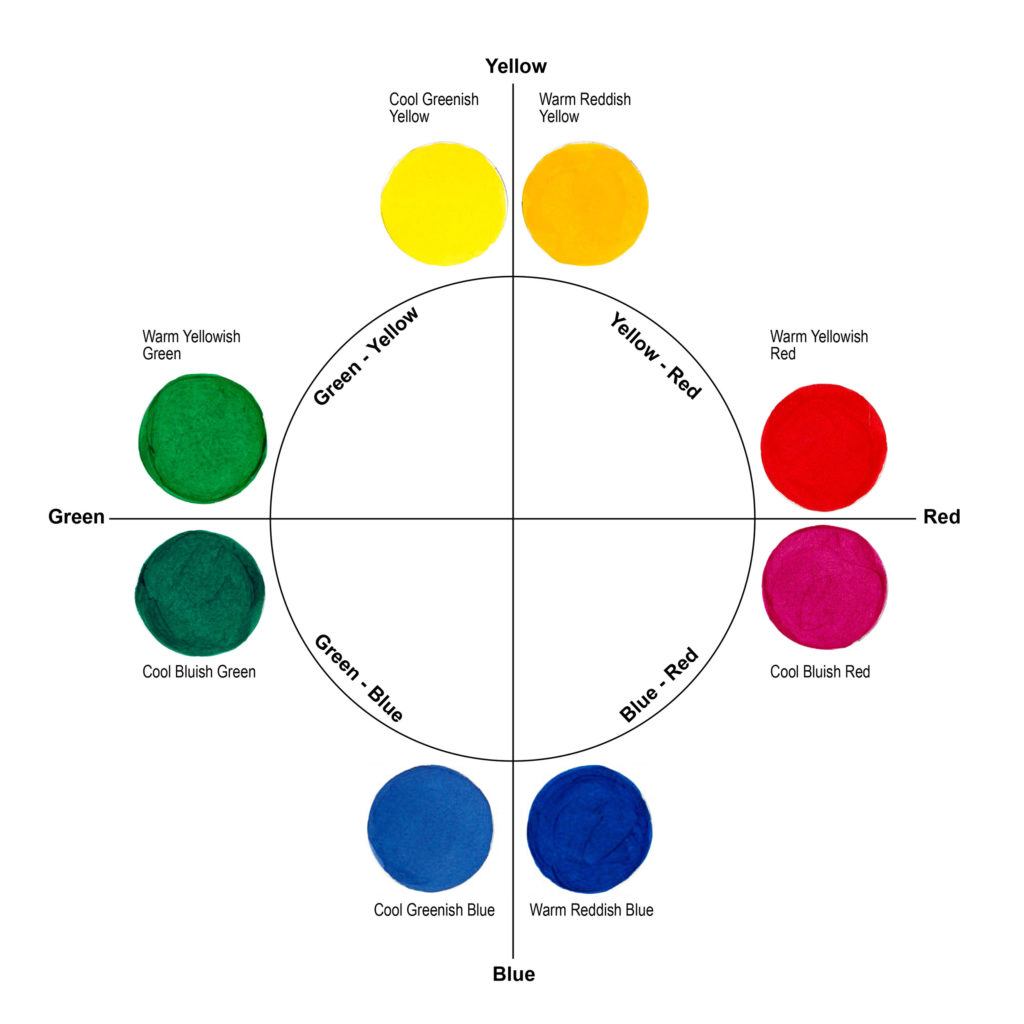
Green doesn’t belong anywhere. In ‘a PowerPoint presentation on why green is the worst colour’, a video essay that is 110% a joke, but still makes a really interesting point, Faline San suggests that green defies color logic. When we think of warm colors, we imagine the physically hot colors: red blood, orange fire, yellow sunshine. When we imagine cool colors, we imagine physically cold colours: blue ice, purpling fingers in the snow. Green straddles the line between both. It is the one color of the rainbow that seems to appear on both the cool and warm sides of the color wheel (depending on which wheel you’re using):

So, of course, horror loves green. It is a naturally unnatural color, a ubiquitous yet strange shade. Green appears in so many different ways across a wide range of horror content that I’ll be covering quite a few movies, and a couple of books. This article will take a look at Aura by Carlos Fuentes, Life and Death: Twilight Reimagined by Stephanie Meyer (yes, really), Green Room, The Silence of the Lambs, The Green Knight, Saw, The Ring, The Exorcist, The Shining, Underwater, and Hereditary.
Overwhelming Nature: Green in Horror
“Green in nature is one thing, green in literature another. Nature and letters seem to have a natural antipathy; bring them together and they tear each other to pieces.”
Virginia Woolf, Orlando
As a color that regularly surrounds us in the grass, trees, and plants, green occupies a unique space in the world of color. Like Woolf explains, it implies an inherent tension in its depiction. Green comes so naturally to the world that when it is used deliberately in something human-made, it seems artificial. It’s like a drawing of a tree made on a piece of paper that’s made from the tree itself. It almost approaches an uncanny valley degree of closeness to truth.
In movies, particularly, green is often used to symbolize Nature, so large and imposing, it is overwhelming. Both 2018’s Hereditary and 2015’s Green Room use their forested backdrops to build a spooky atmosphere. Hereditary uses tall trees to physically cut off the leading family’s home from the rest of the world; it is a physical analog to the oppressive dread that defines the movie’s emotional landscape. The characters seem isolated in their environment, the horror hidden away in some remote corner of the forest. Similarly, Green Room uses the Pacific Northwest and green filters to create a sense of claustrophobia for its characters. Trees cut them off from the outside world. There is a sense that even if they can escape the green room they are stuck in, they will still be lost in the middle of a hostile wilderness that can swallow them whole.
“His eyes are quite green, as if from too much looking at the wood.
There are some eyes can eat you.”
Angela Carter, “The Erl King”
I touch on this in the article about orange in horror, but if you’re in the world of horror and you have something associated closely with nature, it will eventually also take on the meaning of witchcraft and magic. There are different kinds of magic for the different colors. Orange is the color of ritual, purple the color of otherworldliness; green represents ancient, natural magic. It’s the kind of magic you associate with foraging and poultices, with secrets whispered on the back of a breeze, with a perfectly round crop of strange mushrooms.
In The Green Knight, green is the color of magic, particularly the magic of Gawain’s mother, storybook sorceress Morgan Le Fay. It is the scene’s backdrop when Morgan creates the green knight; it is the color of the knight himself. Here, green symbolizes the kind of witchcraft that uses elements of nature, roots and leaves and flowers, to warp the natural order. It does not break the rules; it creates new ones.
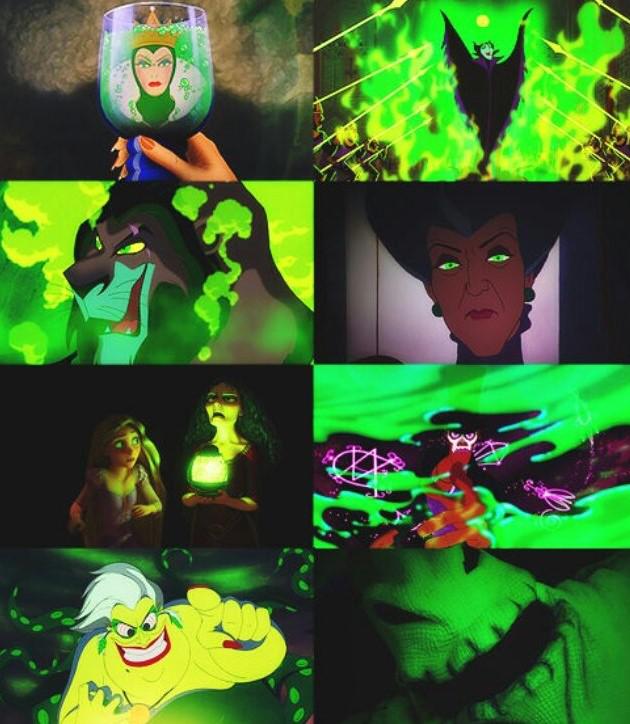
Carlos Fuentes’ horror novella Aura uses green to hint that something magical is happening. Green often symbolizes evil magic, even outside of horror. There is literally a trope of Disney movies using lime green to let you know the villain is onscreen. Think of Maleficent and her dragon fire, Ursula and her cauldron, Dr. Facilier and his conjurings, Tzekel-Kan and his potions (okay, fine, that one is Dreamworks not Disney but I’m already talking about children’s movies in an article about horror so I’ve already veered wildly off-topic).
“Here in the trees it was much easier to believe the stupid words that embarrassed me indoors. Nothing had changed in this forest for thousands of years, and all the old myths and legends seemed much more likely in this ancient green maze than they had in my mundane bedroom.”
Stephanie Meyer, Life and Death: Twilight Reimagined
(This is the “short” bit where I reference Stephanie Meyer; I stand by the opinion that the single best line of writing by Meyer is in her gender-flipped 10th anniversary edition of Twilight because, as someone who lives in the Pacific Northwest, I feel this line so accurately captures the feeling of being in the middle of the forest and suddenly understanding why fairy tales ever came to be; green is the color of the magic of nature, not in like a lame like “ooh isn’t nature a miracle” way but in a creepy “are the trees… moving?” way).
The Circle of Life is Green, Apparently
Green simultaneously symbolizes life and death, something explored in the recent adaptation of The Green Knight. It is the color of chlorophyll, a key compound in most living plants. It is also the color of rot and disease. Think gangrene, think mold, think poison. Green is the grass that covers corpses; green is the unclean wound in the good knight’s arm (at this point, I’m just paraphrasing and may as well just quote the movie directly).
“When you go, your footprints will fill with grass. Moss shall cover your tombstone, and as the sun rises, green shall spread over all, in all its shades and hues. This verdigris will overtake your swords and your coins and your battlements and, try as you might, all you hold dear will succumb to it. Your skin, your bones. Your virtue… Whilst we’re off looking for red, in comes green. Red is the color of lust, but green is what lust leaves behind, in heart, in womb. Green is what is left when ardor fades, when passion dies, when we die, too.”
The Green Knight
In Aura, green symbolizes youth and immortality (while yellow is the color of decay). Fuentes contrasts yellow and green to represent the cyclical nature of life; where green is the bud, yellow is its desiccated corpse. While it seems like green gets the “good” side of the duality, it’s not exactly a positive association. Green does not represent the hopeful possibility of youth; it represents the dreaded, cyclical eternity of a life yet to unfold. After all, the only difference between the bud and the corpse is time. As Audrée Vaillancourt explains in “The implications of the final scene in Aura,” “Green is often associated with nature, creation and women in general. It is the color of immortality, which Aura embodies.” This isn’t “ooh cool I’m a vampire” immortality; this is the curse of endless life.
Seeing the World Through Green-Tinted Glasses
“Finally, you see those eyes of sea that flow, foaming, ebb to calm green, catch fire again wavelike: you see them and tell yourself that it is not true, those beautiful green eyes like all the beautiful green eyes that you have ever known or can ever know. However, you deceive yourself: those eyes flow, are transformed, as if to offer a landscape that only you could imagine and hope for.”
Carlos Fuentes, Aura (translated by Lee Braden)
Green, in horror, is the color of projection. In Aura, for instance, the representation of youth is clearly idealized. Aura’s green eyes offer landscapes that you can “imagine” and “hope for.” That passage is not about Aura’s own experience of her youth and the opportunities it holds; it is about the desire for an ineffable youth that only exists in the imagination of people who could never possess it. It is youth through the green-tinted glasses of middle age: eternal, magical.
Another way that green takes on the meaning of projection is through a specific horror subtrope: the use of night vision cameras and goggles. Night vision scenes add tension to their stories. They plunge the characters into darkness, obscuring details that might make the difference between life and death. The night vision scene does something interesting because it creates a diegetic recording device. What I mean by that is: all movies are recordings of people doing things, but we use our suspension of disbelief to ignore that fact. With a night vision scene, we are made aware that there is a camera recording the event. This is an in-universe cameraperson’s projection of what is happening. It is a subjective scene that follows only a single person’s perspective.
This style of filmmaking makes the characters vulnerable (usually to a hostile antagonist). You see this trope in Rec, Silence of the Lambs, and The Descent. Sometimes, the characters don’t know how scared they should be. The trope uses dramatic irony to let us, the audience, in on things the character doesn’t know yet. A zombie passing in the background of the apartment, an underground creature appearing behind someone’s shoulder.
Silence of the Lambs, in particular, uses the night vision scene to both raise the stakes and comment upon one of its main themes – being witnessed. Clarice, our protagonist, is being watched by Buffalo Bill, the antagonist. He holds the camera; he wields the power. He tells us what we look at and when. The scene is tense because Clarice is at a disadvantage, seen without seeing. (This scene is also awesome because, in spite of this, Clarice is able to successfully protect herself and take down Buffalo Bill shows her reclaiming her narrative by rejecting the male gaze as defined by Laura Mulvey… but I mean hey, that’s another article for another time/an article that has been written and rewritten countless times by other, cleverer people).
Green in the Gills: Disease and Decay
Small, but relevant tangent: green and yellow are often used as contrasting colors, two parts of a duality. The green leaves of spring versus the yellow leaves of autumn. Life and death. Green and yellow. Continuing along this line, in the yellow article, I talk about how yellow is used to symbolize disease and decay. Green also symbolizes disease and decay. But once again, green and yellow form two sides of the same coin. Generally speaking, if you’re seeing yellow in horror and it’s being used to symbolize illness, it represents mental illness. Yellow is the color of anxiety and nervous breaks. On the flip side, green usually represents physical illness (rather than mental). It’s the color of sick rooms, vomit, snot, mucus, viscera.
The term “green about the gills” refers to someone who looks physically unwell. Horror, of course, loves it when people look and feel unwell. According to Meagan Navarro in “From ‘Suspiria’ to ‘Midsommar’: The Psychology of Color in Horror,” “Both The Ring and A Cure for Wellness relied on washed-out tones and greens to convey a sense of sickness. Something is very off in these worlds, and that green is the visual cue.”
Horror movies often use a greenish-blue tint to create a bilious atmosphere. Movies like the Saw franchise and The Ring give off an ethereal uncleanliness; the physical grime is so deeply ingrained it almost transcends into the spiritual or symbolic world. As Lor Gislason explains in “The Many Colors of Horror Films”, “I feel like I need a tetanus shot watching some of these scenes. Do you ever watch a film that just makes you want to have a shower afterward? That’s the Saw films for me. While green is obviously a rich and calming color in plants, for humans it’s never a good thing. Disease, sickness, and infections—all the gross stuff.” In one of the most famous horror movie scenes of all time, The Exorcist’s Regan spews green goo on a very upset priest. The entire scene is flooded with green. From Regan’s unnaturally green eyes to the pea soup snot mixture, the meaning of green is obvious: possession. Green symbolizes an illness of the soul.
That sense of “offness” is often compounded through set design. Mint green, also known as spring green, has a particular place in horror. It is generally a disarming color, one you can imagine on a bedspread or kitchen cupboard. In horror, the otherwise unassuming color hides something sinister. After all, horror loves to make the everyday terrifying. It finds fear in the mundane. When you’re watching a horror movie or reading a horror novel and come across something traditionally comforting (like a doll or the color mint green), you know you need to run. Not to bring things full circle (you know the color green is cyclical and all that) but by taking a natural color and distorting it like this, filmmakers generate a sense of unease.
In The Shining, the mint-green bathroom stands in stark visual contrast to the bold reds and oranges of the other hotel decor. This otherness is a sign of the room’s danger. Often, a mint-green palette foreshadows danger or disaster; the actual climactic scenes don’t usually happen with a mint-green backdrop. However, when you see mint green, you know shit is going to go down: the ship in Underwater is green, as is the orphanage in The Orphan, as are the high school lockers in Hereditary. Green, in horror, lets you know that something is amiss. It signals that a threat is near.
***
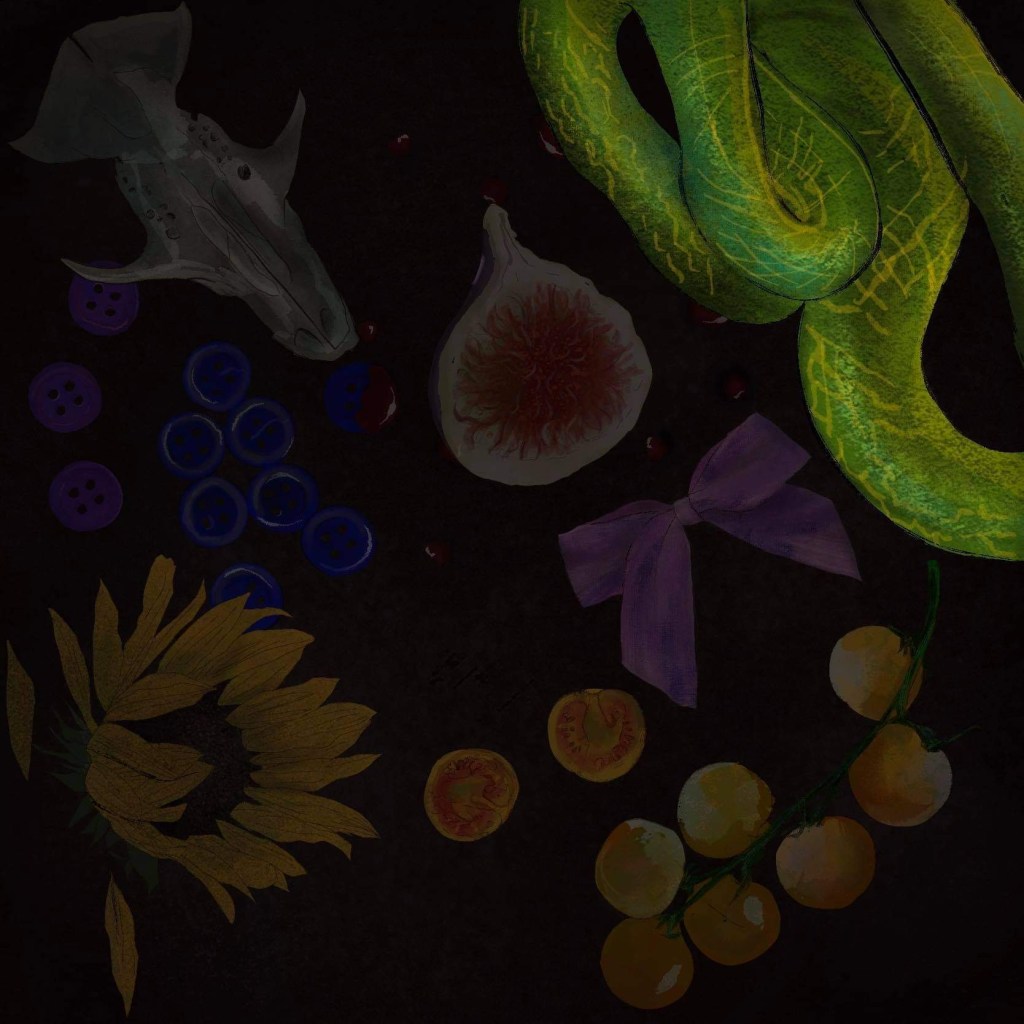
In a nutshell: In horror, green symbolizes suffocation, witchcraft, the natural turned unnatural, disease, immortality, projection, grime, danger (especially when using mint green), and vulnerability (especially when it comes to ‘night vision camera’ green).
Up Next: The Meaning of Blue In Horror


8 comments ›