
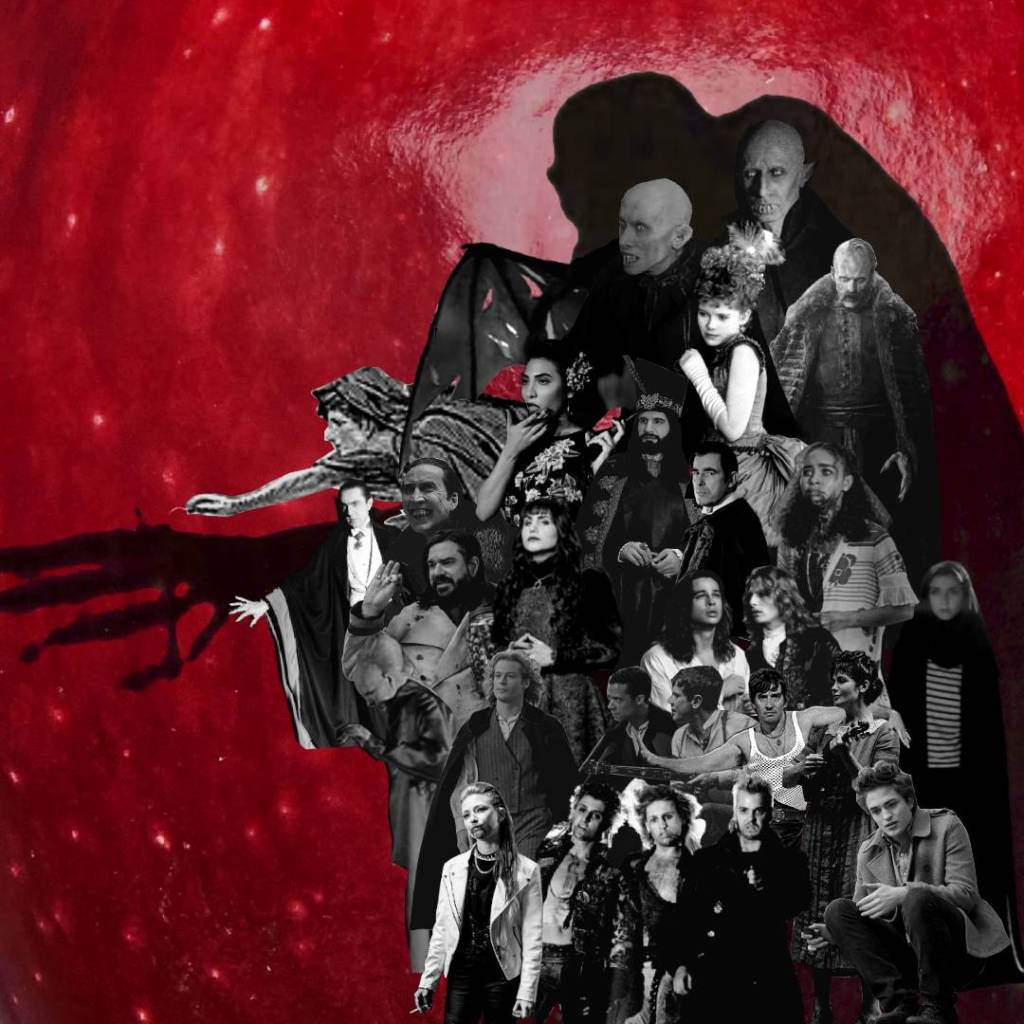
“Vampire cinema overtly sympathizes with the vampire. It overtly shows that vampires can be monstrous, but they indeed can be damned and in that damnation, we can empathize with that sense of guilt and the horror of having to live through pain and self-afflicted pain.”
Sorcha Ní Fhlainn, Vampire and Monster Narratives: An interview with Sorcha Ní Fhlainn
The 2020s have been a real treat for vampire lovers.Twilight is, of course, having a social media revival, but beyond that, we’ve had a whole slew of new and newly adapted vampire stories come to the silver screen. In fact, I recently realized that every movie theatre showing I’ve gone to with my partner all year has been a vampire flick: we kicked the year off with Nosferatu, then saw Sinners, and capped it off with my cinema’s “flashback” showing of 1994’s Interview with the Vampire. Bloodsuckers have returned to the front of the zeitgeist, as they are wont to do once every decade or so.
“I am hunger
I am appetite, nothing more.”
Nosferatu, Nosferatu
For as long as they’ve existed as storytelling devices, vampires have captured our imaginations – a force of evil, desire, allure, hunger. But, as a result, the backlog of stories to read, watch, and otherwise consume is huge. If you haven’t quite caught up with the current wave of vampire media, I’ve compiled a helpful list of the 10 best things for you to sink your teeth into.
Disclaimer: I titled this article “Top 10 Movies,” but that is a lie because I’m not only going to suggest movies. Also, I definitely mention a couple “bonus” suggestions so it’s really more than 10. Also also, I mostly tried to keep this list relevant to the last decade but did not always succeed. Sue me.
Honorable mention: Being Human (2009-2013)
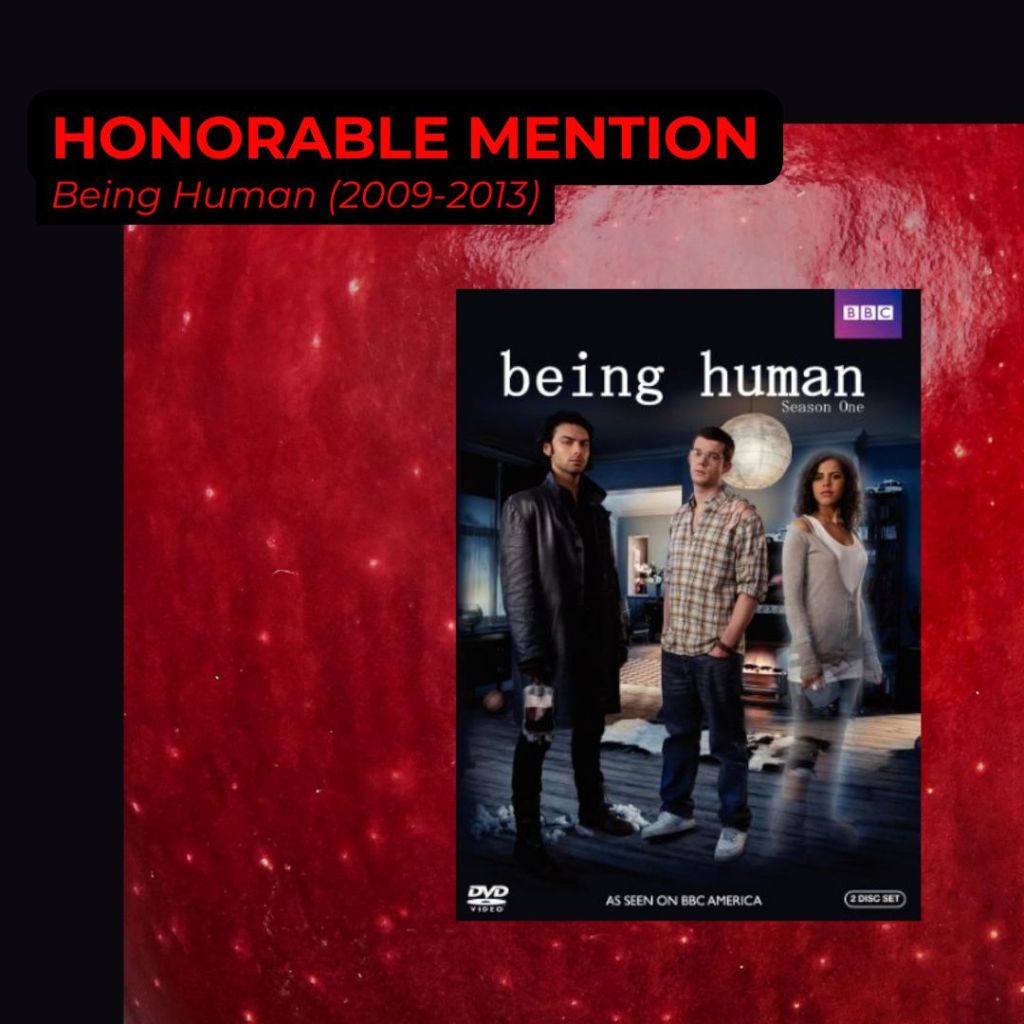
It’s not a movie and it’s not horror, and it’s not an offering of the 2020s, but I still wanted to call out Being Human as a being worth a watch. A BBC series, it follows the lives of three supernatural roommates: a vampire with addiction issues, a werewolf with anger problems, and an agoraphobic ghost. Being Human is incredibly charming, striking a perfect balance between plot and mundanity. It also features Aidan Turner looking incredibly hot in fingerless gloves. Turner’s Mitchell is addicted to two things: blood and sex. The show cleverly intertwines these, blending the supernatural and the human, showcasing the impacts to Mitchell’s life and ability to form relationships.
Like a lot of British shows, Being Human eventually does a cast switch. However, they keep the addiction metaphor going with Hal, the vampire that replaces Mitchell, and they take a pretty interesting approach. For Hal, they lean more into imagery of alcoholism and narcotics addiction than sex addiction, a choice that affects their portrayal of the vampiric experience. Where blood drinking for Mitchell was sensual and physical, Hal more often than not is throwing it back in a glass tumbler.
I have a lot of nostalgia for this show. If you watch it and it turns out to not be good, don’t tell me.
10. The Lost Boys (1987)
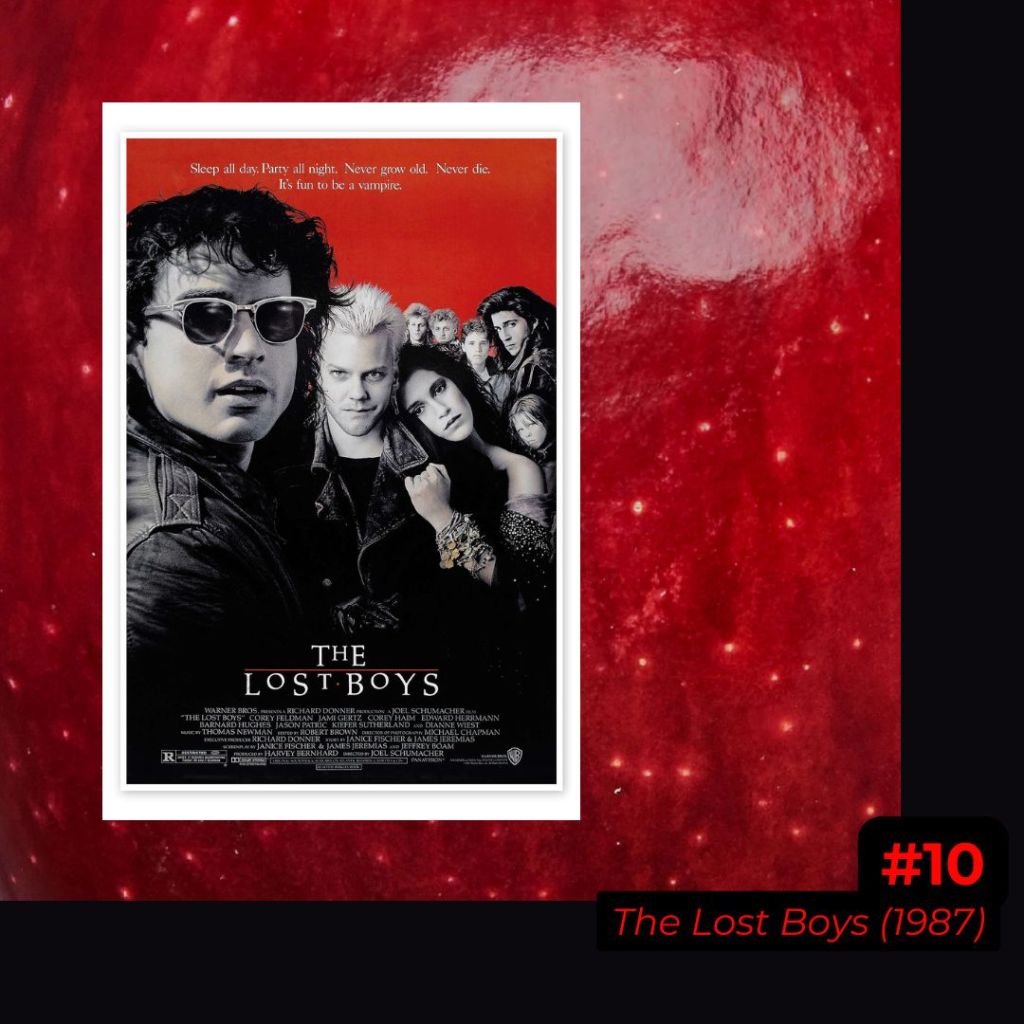
“Sleep all day. Party all night. Never grow old. Never die.
It’s fun to be a vampire.”
Tagline on The Lost Boys movie poster.
The Lost Boys shows up on “top vampire movie” lists like this all the time, but there’s a good reason for it. This movie is pure vibes. It follows brothers Michael and Sam as their mom relocates their family to the fictional Californian city of Santa Carla, also known as the “murder capital of the world.” Unbeknownst to the wider public, a pack of roving teenage vampires rule the Santa Carla boardwalk. The Lost Boys acts as a mirror for cultural concerns of the time – the dissolution of the nuclear family (a concept that had only really been invented a few decades prior), the excesses of a restless adolescence that sees no appeal in the promise of capitalistic success, and the looming threat of HIV. Focused on its teen protagonists, The Lost Boys offers an alluring depiction of the new generation’s general apathy and complete disregard for authority.
“The transgressive nature of the vampire in the movie is not confined to just family and sexuality but also to the wider ideological framework of American capitalism; I now turn to the “eat or be eaten” world of consumerism…
The Lost Boys is created around the world of youth to the total exclusion of adults.
Like [Peter Pan creator J.M.] Barrie’s vision of Neverland eighty years earlier, Michael and [vampire leader] David inhabit a world where adult intrusion is not only to be actively avoided but summarily dispatched. The “lost boys” become an example of resistance that the rest of the youth of Santa Carla seem unable to refuse.”
Simon Bacon, People are Strange: Re-Viewing The Lost Boys
If the above points don’t intrigue you, then this might: The Lost Boys features a scene with the sluttiest saxophonist you’ve ever seen in your life. He’s onscreen for like 20 seconds, but sax guy’s oiled and bare chest looms large in my heart.
9. Bit (2019)

“I picture a world where every woman is a vampire. Let men be the ones who are afraid to fucking jog at night.”
Duke, Bit
While we’re in the realm of Californian vampires, can I ask you to turn your attention to criminally under-watched horror comedy Bit? The movie follows trans teen Laurel, a recent high school graduate who wants to move somewhere that she can make a fresh start. She joins her brother in LA, only to quickly discover a coven of female vampires that have only one rule: they don’t turn men. Laurel finds herself drawn into this neon-noir world of glitz and camaraderie, though she is simultaneously conflicted about the violence that underpins it.
Bit doesn’t necessarily push the envelope when it comes to vampire lore, but that’s to the benefit of its wider themes. In Director Brad Michael Elmore’s own words: “[I] lean[ed] on the audience knowing so much about vampire rules/laws/ideas that I could speed by all that and get to the stuff I was interested in.” Like all the best vampire movies, Bit uses vampirism as a jump-off point to explore other, more earthly concerns. It thoughtfully draws a through line between becoming a vampire and transitioning, exploring how both acts affect not only self-concept, but one’s relationship with others.
I was going to say that this is the perfect vampire movie to watch during Pride month, but, actually, a lot of the movies on this list fit that bill. That’s vampires for you. But, if you want a fun, brightly colored double-feature of horror movies with trans themes, then set up a double billing of Bit and I Saw the TV Glow. You’ll be set.
8. Nosferatu (2024)
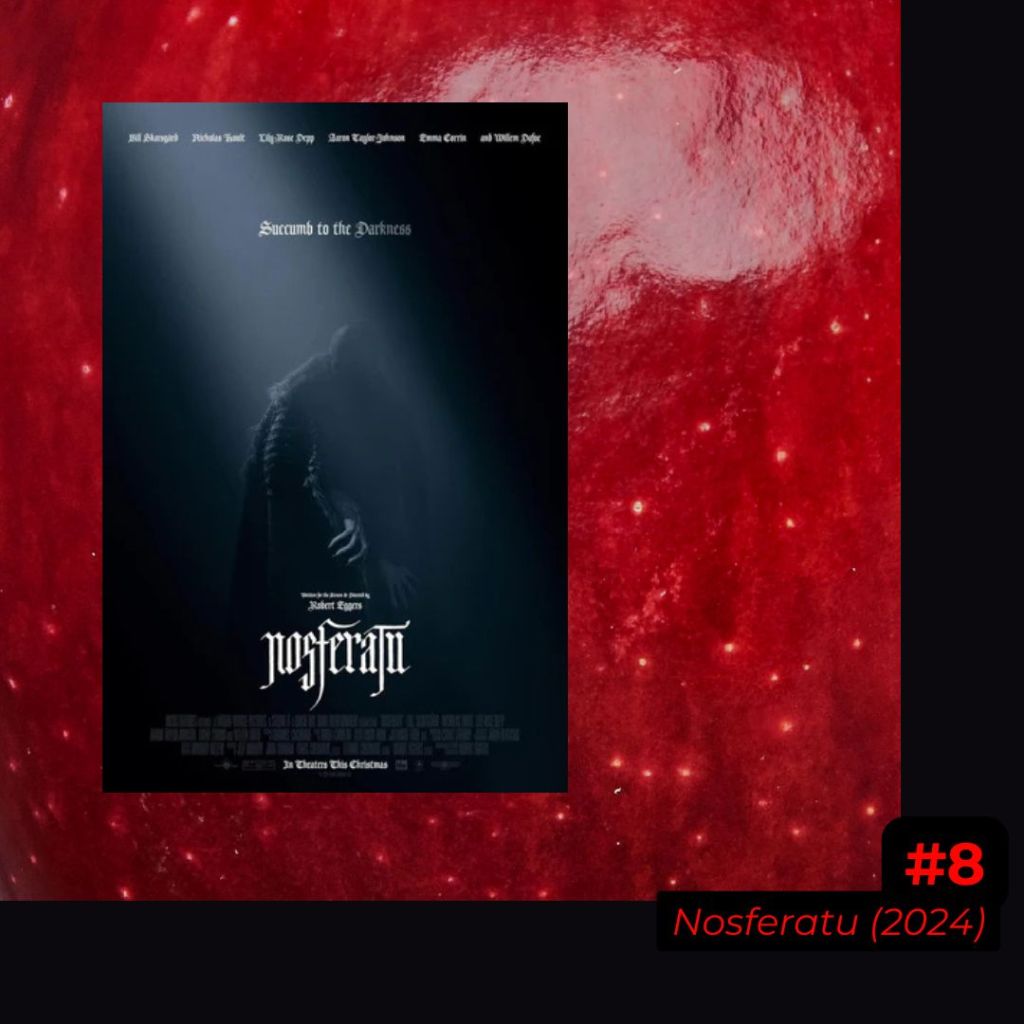
“Professor, my dreams grow darker. Does evil come from within us, or from beyond?”
Ellen Hutter, Nosferatu
There has recently been a rise of horror movies that commit wholeheartedly to classic tropes and storytelling techniques without feeling the need to subvert them. You see this in works such as MaXXXine (and the rest of the X trilogy), Cocaine Bear, The Monkey, and, of course, 2024’s Nosferatu. A gothic retelling of one of the most iconic black-and-white films ever made, every element of this movie oozes capital-R Romance.
A little background on Nosferatu so that you don’t have the experience all my friends had of watching it and being like “wait, why is this sort-of the plot of Dracula but in Germany?” In 1922, F. W. Murnau directed an unauthorized adaptation of Bram Stoker’s hit novel Dracula. Because of the film’s similarity to the novel, the creators got sued and were ordered to destroy all prints. Luckily, some survived, and Nosferatu went on to become a beloved darling of horror fans worldwide. The silent film is a pivotal and beloved work of German expressionism, and also provided one incredibly important addition to the canon of vampire lore: the deadly effect of sunlight. The 2024 adaptation, created around a century later, feels like a real love letter to the original.
Reasons to watch Nosferatu include:
- The visuals. This movie looks spectacular. It uses framing, color blocking, and contrast to convey both emotions, such as dread and despair, and sensory information, such as cold and discomfort. There’s this one scene with a black carriage arriving to pick up Thomas that not only looks, but feels sinister. The bite of winter air nips at your neck, and the darkness descends upon you. You become Thomas, aware that something is amiss but it’s too late to turn back.
- The vampire design. I shan’t give away too many spoilers, but you should know that Count Orlok looks so nasty the entire movie and I love him for it. Just a wet, greasy, bony boy. Perfection.
- The vibes. The entire movie feels like a tragic tarot reading. There’s this foreboding that looms over the characters like a storm cloud, a reminder of the indomitability of fate.
7. Dracula Daily (2021/yearly)

Note: Dracula Daily is not a movie. Because, as aforementioned, I’m a liar.
Note part 2: On pain of death, I’m including a bonus suggestion at the top of this Dracula section: Bram Stoker’s Dracula (1992). I haven’t seen it yet (hence why I didn’t initially include it), but my friend/editor/co-creator of our anthology threatened to personally turn me into a pulp if I didn’t add it to this list. Even though it’s on every vampire watchlist ever published. Apparently, it’s really good. I must also watch it.
Okay. So. Bram Stoker’s 1897 novel Dracula is arguably one of the most famous vampire works ever created. If you’re a fan of the blood-sucking monster, you might feel inclined to go back to the source. (Well, not the source of all vampire lore – that pre-dates the book by hundreds of years across various cultures and it’s also not the first vampire book either, but you know what I mean). However, I have terrible news (which some might vehemently disagree with): Dracula is an incredibly dry read. Or, to be less diplomatic: it’s kind of boring.
Normally, if someone approaches me asking whether they should read Dracula, I say: go read Carmilla. Carmilla came out 20 whole years before Dracula so precedes some of the tropes that Stoker ended up cementing into the canon, and, crucially, it’s a novella of only around 100-200 pages long (compared to Dracula’s 400-500). Also, it’s an erotic story about a sapphic lady vampire, which is a pitch enough for me.
However, regardless of its drabness, I still think Dracula is a worthwhile work to engage with. Enter: Dracula Daily, a substack that sends you little snippets of Dracula every day. Now, I know I sound like one of those Instagram ads that’s all “it’s the Duolingo of vampires” but hear me out: this way of digesting Dracula aligns perfectly with the structure of the book itself.
Dracula is an epistolary novel, consisting of a series of letters, diary entries, medical reports, and newspaper clippings. There isn’t a traditional protagonist but a patchwork of characters that ebb in and out of the narrative:
“Each document provides a distinct viewpoint, contributing to a layered story that unfolds through a mosaic of personal accounts and public records.
This technique invites readers to engage with the story as though they are piecing together a puzzle, experiencing the sense of discovery and revelation alongside the characters.”
Stoker’s Epistolary Approach: Crafting a Multifaceted Narrative
What Dracula Daily does is simple: it sends you today’s correspondence. From May 3rd when the novel starts to November 7th when it ends, you get an email containing only the part of the narrative assigned to that day, whether a letter from Lucy or a scribbling of Dr. Seward. This device brilliantly reinforces the sensation of collective discovery. It becomes as though your good friend Jonathan Harker is writing directly to you. You become attached to his correspondence; you feel the absence when his letters suddenly stop arriving.
6. Life and Death: Twilight Reimagined (2015)
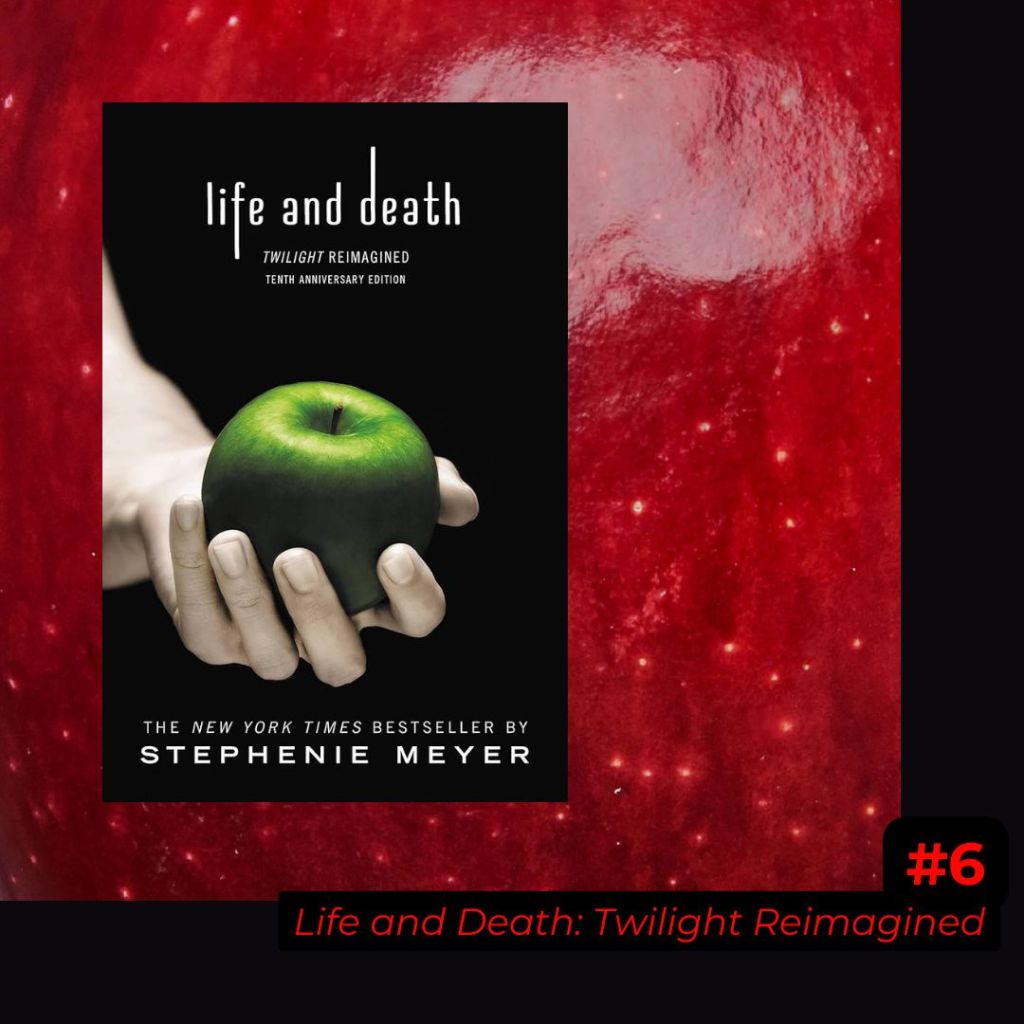
“I’ve always maintained that it would have made no difference if the human were male and the vampire female – it’s still the same story. Twilight has always been a story about the magic and obsession and frenzy of first love.”
Stephanie Meyer, “Foreword” Life and Death: Twilight Reimagined
Did you know that for the tenth anniversary of Twilight, Stephanie Meyer wrote a gender-swapped version of her famed vampire novel? That’s it. That’s my pitch.
Important callout: It’s not just Bella and Edward that are gender-swapped. It is EVERYONE. We’re talking werewolf Jules Black and her mom Bonnie. Mike and Eric become McKayla and Erica. Doctor Carine Cullen lives with her stay-at-home husband Earnest, and their adopted children: Archie and Jessamine, Royal and Eleanor, and, of course, Edythe (Mr. Beaufort “Beau” Swan’s vampiric love interest).
As someone who was a tweenager at the height of Twilight-mania living through a Twilight renaissance now, I couldn’t not include something Twilight-themed for this list. Whether you deeply love it or deeply hate it, you have to admit, it’s taking up a portion of your mind.
A large part of the appeal of Life and Death is that, in spite of Meyer’s claims in the foreword, Twilight is absolutely not the same story with all the gendered differences. The original novel is just too… gender. Or, as Maria Fernanda Amaya Becerril puts it in “How Does the Human Compare to the Vampire? A Close Analysis of An Interview with a Vampire and the Twilight Saga”:
“While still adhering to the Gothic genre, [Twilight] focuses on the heterosexual nature of Bella Swan and Edward Cullin’s relationship and their struggles. It interprets vampires through feminine roles as Bella tries to prioritise Edward over herself.”
Both the films and the books have a very heteronormative, gendered approach to romance. Different traits, expectations, and roles can be segmented into masculine or feminine, and the same holds true of Life and Death. However, Meyer is faithful to the beats of the original story. As a result, you end up with a delightful mismatch of passionately gendered expectations. To illustrate my point, I’ll provide an example. In Twilight, Bella is shorter than Edward. In Life and Death, it is Edythe who is small and Beau who is taller, maintaining those classical expectations of the physicality of heterosexual pairings. But, because the plot doesn’t change, you end up with some very amusing visuals: 6-foot-something Beau clambering onto his tiny girlfriend’s back to be transported to the forest; teensy Edythe saving Beau from certain death by shoving a truck away with one hand.
5. Vampire Hunter D – Bloodlust (2000)
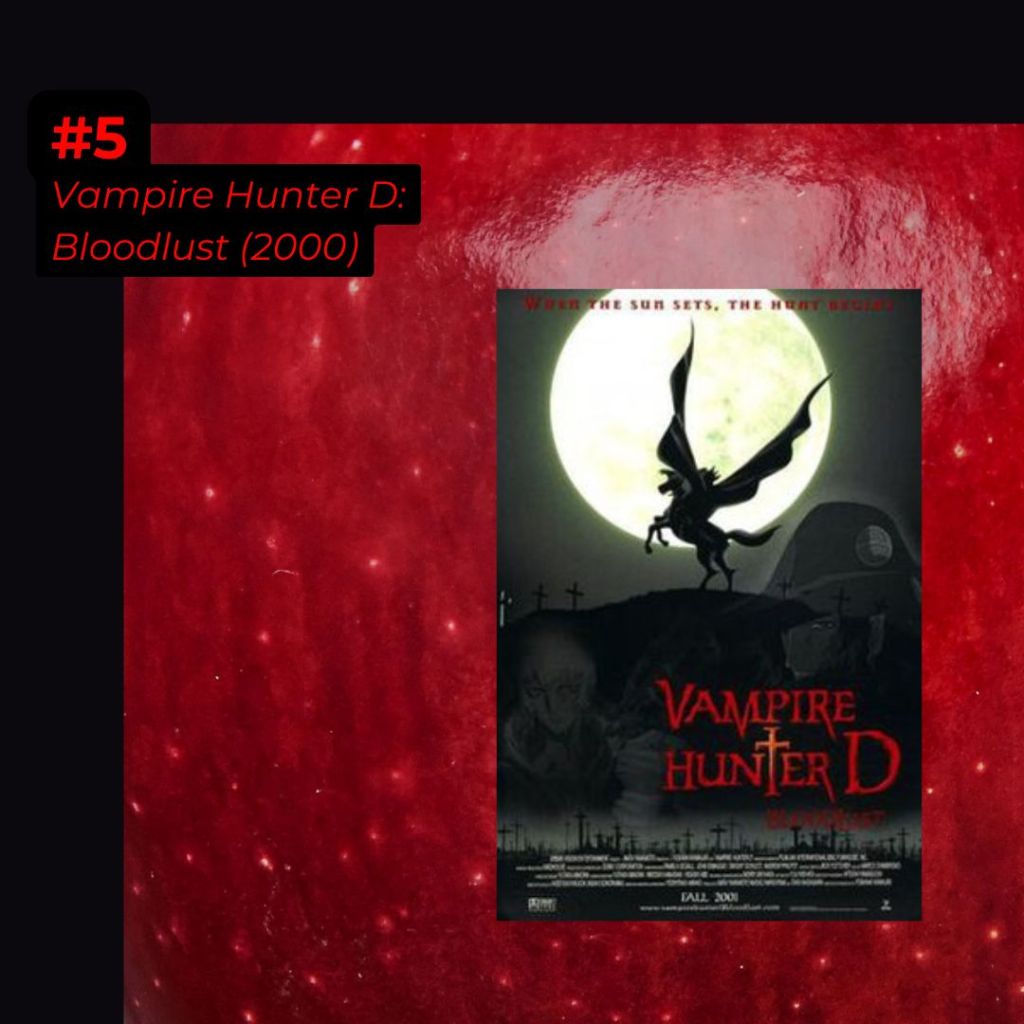
Meier Link: “You should bear in mind, D, that your struggle to resist our nature can’t last forever. One day, the urge for their blood will be stronger.”
D: “And when that day comes, another will hunt me. It’s as simple as that.”
Vampire Hunter D – Bloodlust
My pitch for Vampire Hunter D is simple: it’s really cool. That’s it. A film created during the anime movie era of hyperviolence (also in this category: Ninja Scroll), Bloodlust is kickass. The movie depicts what happens when the daughter of a rich man is kidnapped by a vampire, so he hires a whole crew of vampire hunters to get her back. Among the commissioned hunters is the eponymous D.
The setting is somehow futuristic and apocalyptic, but also gothic and opulent. A straightforward plot, most of the movie is dedicated not to character development or twists, but to lavishing in the world it’s created. From the movie’s very title card the stage is set:
“The distant future… vampires rule the night, but their numbers are dwindling. With huge bounties on their heads, a class of hunters has emerged: Bounty Hunters. One hunter is unlike the rest. He is a dunpeal: a half-human half-vampire. At war with himself, feared by all, tortured and alone, he is… Vampire Hunter D.”
Vampire Hunter D – Bloodlust is like a 105-minute-long animated music video for a metal band called something like Leech or Tears for Blood. By blending classic vampire imagery with mech-style futurism, it sets a unique stage to explore vampire lore. I especially enjoyed its opening scene, which depicts a vampire descending on a town, causing flowers to wilt and crucifixes to crumple.
4. Midnight Mass (2021)
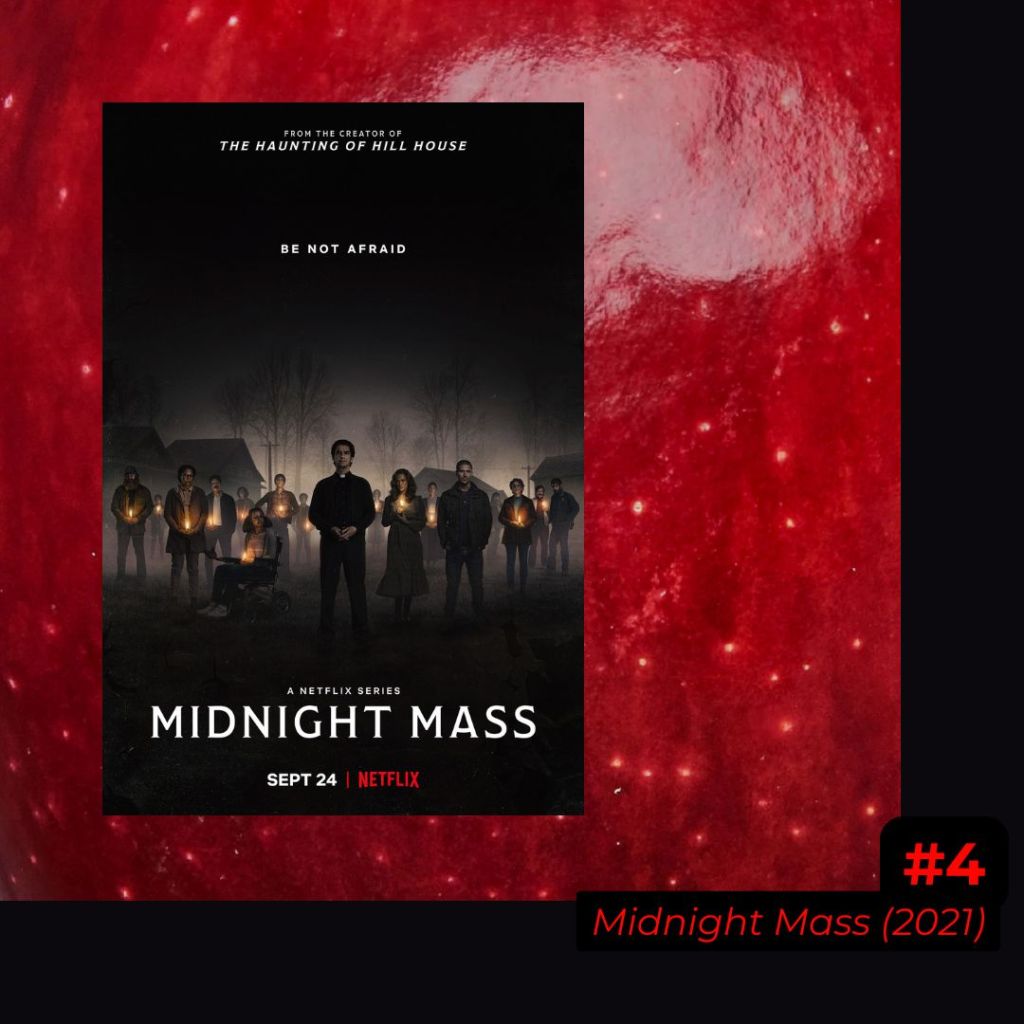
“Bless me, Lord, for I have sinned. No, that’s not right. Bless me, Lord, for I am going to sin.”
Father Paul, Midnight Mass
In the world of horror miniseries, Mike Flanagan is a heavy hitter. His adaptations of classic horror novels and stories have been captivating (I particularly enjoyed Fall of the House of Usher), but it is his original series, Midnight Mass, that holds a special place in my heart.
Set in an isolated little town in the northeast of the United States, Midnight Mass is a story about redemption. It follows an array of visitors that simultaneously arrive on Crockett Island: Riley, a boy born and raised there now returned as a man recently released from prison; Father Paul, the young Catholic priest sent as a temporary replacement while the local Monsignor goes on a holy pilgrimage; the creature, a winged demon that descends on the island with a thirst for blood.
Midnight Mass is just a great spoonful of a story. Though it technically never uses the term vampire (but come on, the thing is obviously a vampire), it dives into some of the less trod themes associated with vampirism. Instead of being about lust, hunger, and desire it’s about religion and faith, addiction and forgiveness. It’s one of those stories where every element feels coherent, down to when and where it takes place. Crockett Island is a deeply Catholic town where the concepts of faith and sin are as abundant as ocean water; the Easter season setting provides a time of year when one reflects on holiness and sacrifice. Each character in the show has an arc and a purpose, offering a new take on the central themes.
My only warning before you watch: the characters in this show have a passion for monologuing at each other. It’s never badly written or out of character; it just happens a lot and for a little longer than you’d expect.
3. What We Do in the Shadows (2014)

“One day I was selling my wares, and I walked past this old, creepy castle, and I look at it and think, ‘Very old and creepy’. And then this creature flies at me! It dragged me back to this dark dungeon, and bit into my neck. And just at the point of death… this creature forced me to suck its foul blood. And then it opened its wings, like this, and hovered above me screeching, ‘Now… You are vampire!’ And it was Petyr. And we’re still friends today.”
Deacon, What We Do in the Shadows
I feel like pretty much everyone has someone in their life who is watching or has watched the What We Do in the Shadows television show. You can identify this person because they have definitely told you (on more than one occasion), “Oh dude, you have to watch it. It’s so good.” This person may, in fact, be you. As someone who recently started watching it (after resisting for years solely because I’m a stubborn dickhead who doesn’t like being told what to do), I understand why this person is like that. What We Do in the Shadows is a genuinely fantastic show (dude, you have to watch it). Its comedy is dark and original, combining over-the-top violence with silliness and mundanity, but its greatest strength is its characters. Everyone who joins the show, whether as main cast or a bit character, seems like they’re having a great time with the material. I have a special love for Nadja, one of the most gremlin-esque women I’ve ever seen committed to television, and Guillermo, who I’ve somehow developed an embarrassing crush on?
But, I’m not here to talk about the show. Your one friend has already done that enough. Instead, I’m here to remind you that it all spawned from one 2014 mockumentary film that is also one of the funniest comedies ever written.*
Following four vampire roommates in New Zealand, What We Do in the Shadows uses a documentary format to detail the mundane lives of supernatural creatures. Each character in the film represents a different vampire “genre,” from the Nosferatu-like Petyr to the dandy Viago to the tyrannical Vladislav to the leather-wearing bad boy Deacon. This structure allows the movie to explore various facets of vampire lore across time and media. However, the film’s greatest strength is its juxtaposition of the commonplace with the extreme. Chore charts and feeding frenzies; flying through the air and squabbling about house rules.
* Massive caveat: something about the humor in What We Do in the Shadows really tickles my exact funny bone. It’s somehow dry and straight-faced, but also ridiculous and camp. If you watch it and, like many of my friends, think it’s not as good as the show, or not really your cup of tea, then that’s fine. Just know that I hate you and think you have no taste.
2. Interview with the Vampire (2022-present)

“Do you know what it means to be loved by Death?… Do you know what it means to have Death know your name?”
Louis de Point du Lac, Interview with the Vampire by Anne Rice
Interview with the Vampire, the 1976 Anne Rice novel, is one of the greatest vampire books ever written. The 1994 movie adaptation had a lot to live up to, and it somehow succeeded (hot tip: if you haven’t yet, watch the movie). With a star-packed cast (Brad Pitt, Tom Cruise, Kirsten Dunst, and Antonio Banderas, to name a few) and lush visuals, it captured Rice’s novel in elegant detail. That’s 2 for 2. So, when a show of the same franchise got announced in the early 2020s, there was a lot riding on it. Luckily, it exceeded expectations.
The Interview with the Vampire show gave me hope for modern adaptations. So many of my beloved childhood stories are being made or remade onto the small screen, and it rarely goes well. I avoided Interview with the Vampire initially, worried it would be more Percy Jackson, Rings of Power, Avatar the Last Airbender than Watchmen, Series of Unfortunate Events, Babysitters Club. But at a friend’s insistence, I gave it a shot. And now, here I am, singing its praises for you to do the same.
Interview with the Vampire is a story about vampire Louis de Pointe du Lac telling a reporter his life story. I won’t say much more, because if you know nothing about the plot, I think you deserve to enter it sans spoilers, but the original novel pretty much defined the relationship between vampires and the southern gothic. For an in-depth look at how it brought vampires to the USAmerican South, I recommend checking out Princess Weekes’ Why Are There So Many Confederate Vampires? While the movie and book are great, the show feels like a fresh take on the concept. It makes a couple of character, plot, and timeline tweaks that really bring to life the central premise of the story: this is an interview, with a narrator who has a viewpoint, agenda, and biases.
The only reason I created this list was to put off writing a much longer article (which I will eventually publish) about how refreshing it is as a show not only in its approach to its own story, but to television writing in general. My thesis is: too many shows feel like they’re vying for my attention, doling out plot twists and intrigue at the correct intervals to keep me watching, having little faith in my willingness to sit with “filler.” Interview with the Vampire lures you in; character relationships and development to drive the story beats rather than optimal plot structure. It’s a show unafraid of taking its time, letting you bask in its setting and get to know its characters.
1. Sinners (2025)

“You keep dancing with the devil… one day he’s gonna follow you home.”
Jedediah, Sinners
“Look at that sky. That’s a mighty fine day to be free, ain’t it? Our own juke joint. For us and by us, just like we always wanted.”
Stack, Sinners
If Sinners is still playing in a theater near you, then stop reading this minute and go buy a ticket. It’s one of those movies that really suits the big screen. Go!
Sinners sits at the top of this list not because it’s the best vampire movie I’ve ever seen, or even my favorite, but because it’s one of those movies that’s so worth a watch. Like Knives Out or The Autopsy of Jane Doe.
The movie’s plot is fairly straightforward: set in Mississippi in 1932, it depicts the opening night of a juke joint owned by twin brothers Smoke and Stack. Recently returned from a stint in Chicago (where they may or may not have worked for Al Capone), the brothers recruit their younger cousin Sammie to play at their venue. Sammie, a brilliant blues musician, serves as the perspective character that guides us through the story, which sees the twins’ endeavor turn from successful to threatening when vampires descend on the establishment.
It’s hard to describe Sinners and accurately capture its vibe, but I’ll give it a go: Sinners is a more thoughtful version of From Dawn til Dusk. Sinners is a period piece that’s mostly character focused, but it’s also a supernatural story that presents some very fun and eerie vampire lore. Sinners is a movie about freedom, Black liberation, and justice. It’s a movie about love and community. It’s a thesis on music and its meaning to us as a species.
I’ll break down the praises for Sinners into two parts, and in both, I’ll try to be brief: 1/ its approach to vampires, 2/ its approach to history.
It’s approach to vampires
I’ll start with a minor thing I like about the design of vampires in Sinners: it gives vampires these weird reflective eyes, like when you see a cat in the dead of night. This small update works very well to make them stand out without having to literally show pointy teeth. You see a character wander into the woods for a piss and your heart stops when you see a flash of green among the leaves.
More broadly, I appreciate Sinners’ incredibly traditional approach to vampire lore. The vampires in Sinners can’t cross thresholds without being invited in and must avoid the sun; garlic, holy water, and silver harm them while wooden stakes prove deadly. I’ll admit, I have a special soft spot for vampires that have garlic as a weakness in the same way that I prefer Christmas movies where Santa is real. It shows that the movie understands its own appeal without being embarrassed about some of the more extravagant elements of its genre.
“So for me, the vampire was a creature who’s, like, human-adjacent – who was human at some point, you know, became something else. But through their advanced age, they could see society for what it was.”
Ryan Coogler, Ryan Coogler says ‘Sinners’ inspiration felt ‘like a bolt of lightning’
Its approach to history
If I had to pick a genre for Sinners, it would be “horror period piece.” Vampire movies do tend to have a historical leaning, but often this places them in a Victorian or Gothic-inspired setting. We can probably blame the success of Dracula on that, but it means it’s always refreshing when you get a lavishly painted setting that provides something new. Sinners takes its time to draw you into 1930s Mississippi.
All the characters feel lived in, their relationships weighty. You can feel the history between everyone, and this extends this beyond characters that have the strongest bonds. Mary, Smoke’s love interest, doesn’t just have an interesting and storied past with Smoke. She has a relationship with Stack, with Sammie, with Stack’s wife Annie and with the juke joint’s bouncer Cornbread. This courtesy extends to all characters. It feels like you’re watching an interconnected web of histories and dramas; that is, it feels like watching a community.
And then, the way that these two elements, the vampires and the history, are interwoven is what really cements the movie as a thoughtful, lovingly crafted piece of art. I think Nadira Goffe puts it best in The Villains of Sinners Aren’t Who You Think:
“A less ambitious movie would build its binary of good and evil off the chilling imagery of the vampires at the door, simplifying the matter to “vampires = white predators” and “humans = Black victims and heroes.” Thankfully, Coogler is not that kind of filmmaker, and Sinners is not that kind of movie. If the movie’s white, bloodthirsty monster is not the true villain of Sinners, then who—or what—is? The answer lies in the film’s interrogation of the lengths you’d consider going to escape structural torment. The greatest evil here is white supremacy, the system of structural racism and bigotry underlining all aspects of life in 1930s Mississippi.”
***
The vampire movie is almost as old as cinema itself. Across time, vampires have clearly captivated our imagination, providing a fertile ground for storytelling. Somehow, there’s always something new to say, some new power or weakness to add to the lore. It’s a living legend, one that has had some amazing additions in recent years, and one that I have faith will continue to evolve in years to come. For now, I hope you enjoy these offerings. I know that I did.
“This is a book about vampire movies, but it is a book that I am tempted to say almost does not need to be written. This is not because there is not a lot to say about vampire movies, but because a characteristic feature of vampire movies is that they do the saying themselves”
Jeffrey Andrew Weinstock, Introduction”, The Vampire Film: Undead Cinema
 Slow Burn Horror
DO YOU WANT TO BECOME A Vampire? In recent times, humans want extraordinary qualities to defeat all obstacles and achieve every goal and ambition in life. Becoming a breed of lycanthropus, a blend of the Vampire and acquiring hircine’s gifts, enables one to live a powerful life. Join the seventh sixth pack of the Hademus, know the shapeshifting techniques, spells, feel among, and enjoy supernatural gifts. If you really want to become a Vampire, contact (EMAIL) vampirefamilydiaries@gmail.com,(SIGNAL) +1 409-293-3758, (WHATSAPP) +1 256-673-0139.
LikeLiked by 1 person